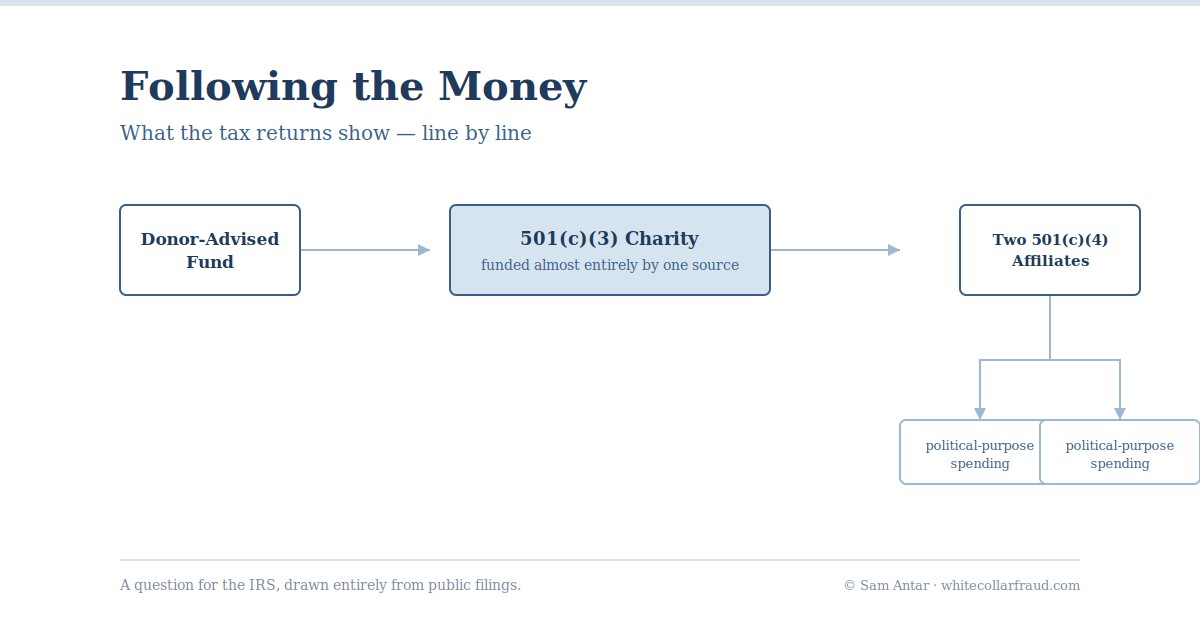
Between 2018 and 2024, the Justice and Education Fund — a New York 501(c)(3) charity that congressional investigators and The New York Times have placed within the network financed by the businessman Neville Roy Singham — received $68,773,701 from a single donor-advised fund, nearly all of its reported contributions in five of those six years, and passed $25,991,000 on to two affiliated 501(c)(4) organizations. The charity and the organizations around it share senior officers, a New York operating address, and a single Illinois bookkeeping office, and the two affiliates filed near-identical disclosures prepared by the same return preparer. Those two affiliates reported $22,503,500 in political-purpose spending on Form 1120-POL — the return political organizations file. And on the federal tax returns where a related organization would be disclosed if the reporting tests are met, each answered “No.” Taken together, the filings trace tax-deductible charitable dollars toward political-purpose spending — and raise the question at the heart of this article: whether contributions that entered the system as tax-deductible charity were, in substance, turned into political spending.
Their own filings document every step.
A Tax Question, Not the Influence Debate
Neville Roy Singham’s network of American tax-exempt organizations is being examined by congressional committees as a foreign-influence question — whether it functions as a vehicle for Chinese state messaging. That inquiry is real, it is contested, and others are pursuing it: the House Ways and Means Committee, which oversees the tax-exempt sector, has demanded records from The People’s Forum — one of the organizations in this network — as part of a broader investigation into possible abuse of tax-exempt status.
This article is about something narrower and — for the people whose job is enforcement — more immediately actionable: a tax-compliance question that can be answered without resolving any of that. It does not require anyone to agree about China, about politics, or about Singham. Singham himself is not the subject here; the subject is the money, and what the participants’ own tax returns do and do not show about it.
Whatever an organization’s mission or politics, a 501(c)(3) public charity and the 501(c)(4) organizations it funds must follow the same Internal Revenue Code as every other tax-exempt organization in the country. That compliance is not a matter of opinion or motive; it is testable, line by line, on the returns these organizations filed with the IRS under penalty of perjury.
The Funding Chain
It begins where the public record is clearest. For five straight years, almost every dollar one New York charity reported taking in came from a single donor-advised fund — and the charity passed tens of millions of those dollars on to two affiliated organizations that, on their own returns, report spending on political-purpose activity.
The narrow question: when a charity is funded almost entirely by one source and routes millions to organizations that report political-purpose spending, do its filings describe that accurately, and were charitable dollars used for charitable purposes?
Why It Matters, and What the Code Provides
Why this matters turns on classification. The Justice and Education Fund reports to the IRS as a publicly supported charity — one that draws its support broadly from the public rather than from one or two sources — and claims a 99.91% public-support percentage. That status is not cosmetic.
Grants from a donor-advised fund are generally counted as public support, so the 99.91% figure can stand on the face of the returns even when nearly all the money arrived through a single fund. What the public records cannot show is who advised those grants. If the unredacted records were to establish that the support traced, in substance, to a single donor behind the fund, the Service could reclassify the charity as a private foundation — a change that would reach backward and expose the charity’s own $25,991,000 in grants to the two 501(c)(4)s to the excise regime of Internal Revenue Code section 4945 — 20% initially, and 100% if uncorrected.
Other consequences follow the same conditional logic, regardless of the source of the incoming funds: if charitable funds served non-charitable purposes, exempt status can be revoked; incomplete or incorrect returns carry their own penalties. None of that is established here — each is a consequence the law attaches only if the questions that follow are answered against the organizations.
The Donor the Returns Don’t Name
Because the money entered through a donor-advised fund, the public returns never name the donor who recommended the grants. The businessman whom The New York Times and members of Congress have publicly identified as the financial backer of this network is Neville Roy Singham; whether he was the donor behind these particular grants, and whether the donor-advised-fund structure was used as intended, are among the questions only the unredacted records can answer.
But the donor’s identity is a separate question from the one at the center of this article — and the second does not depend on the first. Whoever advised the grants, the documented chain is the same: tax-deductible dollars entered a charity, that charity moved $25,991,000 to two 501(c)(4)s, and those affiliates reported political-purpose spending. Whether charitable contributions were turned into political spending — and whether the charity’s filings describe what happened accurately — turns on what the money did, not on whose name sits behind the fund. Naming the donor would sharpen the public-support question; it would change nothing about the conversion question, which the returns raise on their own.
What This Article Does, and Doesn’t, Claim
This article documents that chain in the organizations’ own federal filings, available to anyone through the IRS and ProPublica. The findings have been referred to the Internal Revenue Service.
The purpose of this investigation is not to pronounce a verdict but to provide a roadmap — to trace, line by line through the public returns, where the money went and where the documents stop, and to point the Service toward the non-public records that can answer the rest.
It raises the questions those documents pose; it does not assert their answers, and it does not allege that any organization or individual broke the law. Whether any tax is owed, or any status misstated, is for the IRS to determine.
The chain, in one picture
| Step | Who | What the filings show |
| 1 — Source | Goldman Sachs Philanthropy Fund (a 501(c)(3) donor-advised fund) | $68,773,701 in cash grants to The Justice and Education Fund, 2018–2023 |
| 2 — Hub | The Justice and Education Fund (a 501(c)(3)) | Reports 99.91% public support; the single fund above supplied roughly 99% of its contributions in most years |
| 3 — Transfer | Justice and Education Fund → two 501(c)(4) affiliates | $25,991,000 to People’s Welfare Association and United Community Fund, 2019–2024 |
| 4 — Political-purpose spending | Both 501(c)(4) affiliates | Each reported political/exempt-function spending and filed Form 1120-POL: $4,203,500 (PWA, three years) and $18,300,000 (UCF, one year) |
| 5 — Disclosure | The charities in the chain | Answered “No” to having a related organization — on the same returns that report shared officers, a shared address, and grants between them |
Step 1: One donor-advised fund, six years, $68.7 million
The Goldman Sachs Philanthropy Fund (EIN 31-1774905) is a 501(c)(3) that houses donor-advised funds — accounts where a donor takes the charitable tax deduction up front and later recommends where the money goes. On its own Form 990 Schedule I, it reported cash grants to The Justice and Education Fund (EIN 82-4975378) in six consecutive years:
| Year | Grant to the Justice and Education Fund |
| 2018 | $5,545,000 |
| 2019 | $15,255,000 |
| 2020 | $7,650,000 |
| 2021 | $10,025,000 |
| 2022 | $20,630,000 |
| 2023 | $9,668,701 |
| Total | $68,773,701 |
Source: Goldman Sachs Philanthropy Fund Forms 990, Schedule I, 2018–2023, naming “Justice and Education Fund,” EIN 82-4975378.
Because the money moved through a donor-advised fund, the returns do not name the donor who recommended the grants. Who that was, and whether the donor-advised-fund structure was used as intended, are questions the IRS can answer from records the public cannot see.
Goldman also was not the only donor-advised-fund sponsor among the charity’s funders; filings indicate grants from others as well, including Fidelity Charitable, a Schwab-affiliated fund, and the National Philanthropic Trust.
Step 2: A charity funded almost entirely by one source
The Justice and Education Fund reports to the IRS as a publicly supported charity, with a public-support percentage of 99.91% on its 2023 Schedule A. “Publicly supported” status generally depends on drawing support from a broad base rather than one or two large sources.
Set the Goldman grants against the charity’s own reported contributions:
| Year | Charity’s total contributions | Goldman grant | Goldman share |
| 2018 | $5,581,100 | $5,545,000 | 99.4% |
| 2019 | $15,307,235 | $15,255,000 | 99.7% |
| 2020 | $7,715,753 | $7,650,000 | 99.2% |
| 2021 | $10,471,611 | $10,025,000 | 95.7% |
| 2022 | $20,692,798 | $20,630,000 | 99.7% |
| 2023 | $18,688,582 | $9,668,701 | 51.7% |
Source: Justice and Education Fund Forms 990 (total contributions) and Goldman Sachs Philanthropy Fund Schedule I (grants), 2018–2023.
For five of the six years, one donor-advised fund supplied between 95% and nearly 100% of the charity’s reported contributions. The charity’s own auditors describe the same concentration: a note titled “Concentration of Support” in its audited financial statements states that two and one contributors, respectively, accounted for roughly 99% and 100% of contributions and grants revenue in 2023 and 2022.
The question this raises is more specific than it first appears. Grants received through a donor-advised fund are generally counted as support from a public charity — which is why a figure like 99.91% can sit on a return even when nearly all the money arrives through a single pipe. What that figure cannot show is who advised the grants behind the fund, or whether, in substance, they trace to one source. That is a question for the IRS, which can review the charity’s unredacted donor schedule.
Step 3: $26 million moved from the charity to two political-spending affiliates
The Justice and Education Fund is organized under section 501(c)(3) — the part of the code for charities, which limits political activity. On its own Schedule I, it reported grants to two organizations it coded as 501(c)(4) social-welfare groups, the part of the code that permits political activity:
| Year | To People’s Welfare Association | To United Community Fund |
| 2019 | $876,000 | $8,330,000 |
| 2020 | $3,427,000 | $170,000 |
| 2021 | $3,845,000 | — |
| 2022 | $1,284,000 | — |
| 2023 | $5,749,000 | — |
| 2024 | $2,310,000 | — |
| Total | $17,491,000 | $8,500,000 |
Source: Justice and Education Fund Forms 990, Schedule I, 2019–2024. Combined total: $25,991,000.
Each grant was described on the charity’s return only in general terms — “charitable, religious, literary or educational purposes.” A 501(c)(3) is allowed to grant money to a 501(c)(4). The question is what happened to charitable-side dollars once they arrived at the next two organizations.
Step 4: Both recipients reported political-purpose spending
This is the heart of the matter. Both 501(c)(4) recipients reported, on their own tax returns, that they spent money on political-purpose activity and filed Form 1120-POL — the return political organizations use.
People’s Welfare Association reported political/exempt-function spending in three consecutive years:
| Fiscal year ended | Reported on Schedule C | Form 1120-POL |
| April 30, 2022 | $1,875,000 | filed |
| April 30, 2023 | $1,201,500 | filed |
| April 30, 2024 | $1,127,000 | filed |
| Total | $4,203,500 |
United Community Fund, in its first year (fiscal year ended September 30, 2019), reported political/exempt-function spending of $18,300,000 on its Schedule C and reported filing Form 1120-POL. In later years it wound down and reported no further political spending.
Source: People’s Welfare Association and United Community Fund Forms 990, Schedule C, with Form 1120-POL indicated on each.
Both organizations used nearly identical language to describe the activity. Each said it supports foreign grantees whose activities “could be deemed direct or indirect campaign activity (within the meaning of the regulations under section 501(c)(4)),” and each labeled grant lines on its own Schedule F as “social welfare support to grantees that may engage in political activity.” Both reported zero employees and three directors.
None of that is unlawful for a 501(c)(4): these organizations may engage in political activity, and they reported and paid tax on it. The question runs the other direction — back to the charity.
When a 501(c)(3) sends $26 million, described only as charitable, into two organizations that then report political-purpose spending, were those charitable dollars used for charitable purposes? The returns describe the grants in general terms and do not answer that. The IRS can review the grant agreements and trace the funds; the public cannot.
Step 5: “No related organization” — on the same returns that show shared officers and shared addresses
The organizations in this chain are presented on their returns as independent. Yet the same two people ran the senior operations of two of them. Manolo De Los Santos appears as Executive Director of The People’s Forum and, in the same years, as the Justice and Education Fund’s Secretary and only paid officer ($80,000). Sung Mo (David) Chung appears as The People’s Forum’s General Manager and, in the same years, as the Justice and Education Fund’s Chair.
On the very returns disclosing those overlapping roles, both organizations answered “No” to whether they had a related organization and reported $0 in compensation from related organizations.
One year is especially direct: the Justice and Education Fund’s 2020 Schedule O states that “at no point during the reporting year did the organization engage in transactions with… a related organization” — the same return reports grants to The People’s Forum and to a media affiliate at the same address, and lists De Los Santos as a paid officer of both organizations.
The threads tie together at a single bookkeeping office, too: Scali & Associates of 190 Liberty Road, Crystal Lake, Illinois, appears as The People’s Forum’s accountant, as the keeper of People’s Dispatch’s books, and as the Illinois home of the Justice and Education Fund’s own Brazilian-property holding companies.
The contrast sharpens in the charity’s own audited financial statements. A note titled “Related Party Transactions” in the Justice and Education Fund’s 2023 audited financials describes The People’s Forum as “a related party through common management and Board of Director members” and reports transactions with it in both directions — donated office space coming in, donated accounting services going out.
That is the charity’s own auditors calling The People’s Forum a related party in the same year its federal return certifies it had no transactions with a related organization. The two documents use different definitions — the accounting standard for a “related party” is not identical to the tax form’s “related organization” — so the two disclosures are not necessarily in conflict. But whether they can be reconciled is exactly the kind of question the IRS is positioned to answer.
Two people serving two charities does not automatically make them “related organizations” in the technical sense the tax form uses. But whether these organizations should have disclosed a relationship is a fair question — and one the IRS can resolve from governing documents and board records that are not public.
How a Charitable Deduction Can End Up Funding Politics
Step back from these particular organizations for a moment, because the structure they form is one the public should understand on its own terms — it is built from pieces that are each ordinary, and that is exactly what makes it worth explaining.
A donor-advised fund is a charitable account with a specific bargain behind it. A donor gives money to the fund, takes the full charitable tax deduction in that year, and gives up legal ownership; the sponsor — itself a public charity — takes control, and the donor keeps only the right to recommend where grants go. In exchange for that up-front deduction, the law expects the money to be used for charity. And the donor’s name drops off the public record: when the fund makes a grant, its return shows the fund as the giver, not the person who advised it.
Now follow what that makes possible. A 501(c)(3) public charity is sharply limited in how much it can touch politics. A 501(c)(4) social-welfare organization is not — it may spend on political-purpose activity, so long as it reports and pays tax on that spending. And a 501(c)(3) is permitted to make grants to a 501(c)(4). Line those rules up and a path appears: tax-deductible dollars enter a donor-advised fund; the fund grants them to a friendly 501(c)(3); that 501(c)(3) grants them to a 501(c)(4); and the 501(c)(4) spends on politics. At each step the paperwork is clean, and each transfer, taken by itself, is something the rules allow.
Here is where the law draws its line. The deduction is for charity, and charitable dollars are supposed to stay charitable. A 501(c)(3) may not serve as a conduit that routes a donor’s money toward the donor’s own political ends, and the anonymity of a donor-advised fund is not supposed to become a way to obscure that it did. Whether a given series of transfers is ordinary charitable grantmaking or a structured route from a tax write-off to political spending turns on facts the public cannot see — who directed the money, what the grants were conditioned on, and whether the charitable label matched the actual use. Those are exactly the records the IRS can compel and the public cannot.
That is why the chain documented above matters beyond the organizations in it. The public can see the shape on the face of the returns: one fund supplying nearly all of one charity’s money, that charity feeding two political-spending affiliates, the same people and the same address running more than one of them. What the public cannot see is whether that shape is coincidence or design. The IRS can.
Substance Over Form
Federal tax law has long looked to how an organization actually operates — the substance — rather than to how its structure appears on paper — the form. For tax-exempt organizations that principle is written into the statute: the operational test of Internal Revenue Code section 501(c)(3) (Treasury Regulation section 1.501(c)(3)-1(c)(1)) requires that an organization be operated, in fact, exclusively for exempt purposes — whatever its organizing documents or the labels on its returns may say.
That is what makes this chain worth examining, because no single step is unusual on its own: a donor-advised fund may grant to a public charity, a 501(c)(3) may grant to a 501(c)(4), and a 501(c)(4) may report and pay tax on political-purpose spending. Each transaction, viewed alone, looks routine.
The questions arise only when the steps are read together. A label on a return — “publicly supported,” “charitable,” “no related organization” — describes a form. What the same returns disclose about how these organizations are funded, how their grants are used, and who runs them describes the substance. Where the two diverge, tax law allows the Service to look past the label to the operational reality — and whether they diverge here is what the unredacted records can answer.
The questions, in one place
Read together, the filings raise questions the IRS is positioned to answer:
- When one donor-advised fund supplies almost all of a charity’s money for five straight years, is a 99.91% “public support” figure accurate?
- When that charity moves $26 million into two political-spending affiliates, described only as charitable, were the funds in fact used for charitable purposes?
- When the recipients’ own returns report $22.5 million in combined political-purpose spending, does that bear on the charity’s tax-exempt purpose?
- When the same returns that report shared officers and shared addresses also certify “no related organization,” are those certifications accurate and complete?
These are questions, not conclusions. The IRS has the records, the subpoena power, and the authority to answer them.
Methodology and a note on corrections
Every figure in this article is drawn directly from the organizations’ own original IRS Form 990 filings — the electronic returns as filed — and, where expressly identified, from the organizations’ own audited financial statements filed with the New York State Attorney General’s Charities Bureau and open to public inspection; and verified against each organization’s original return as filed, not against any third party’s summary or analysis. The underlying returns are public and are hosted in full by the IRS and by ProPublica’s Nonprofit Explorer, to which this article links for the reader’s convenience.
Dollar amounts trace to specific forms, schedules, and lines: contribution totals and grants from each filer’s Schedule I and Part VIII; political-purpose figures from Schedule C with Form 1120-POL indicated; officer roles from Part VII; related-organization answers from Part IV and Schedule O; and the concentration and related-party notes from the audited financial statements where cited.
Neville Roy Singham is named in this article as he has been identified in public reporting and in congressional correspondence; consistent with the donor-advised-fund structure examined above, his name does not appear on any of the tax filings discussed here.
The author is a forensic accountant and a registered Democrat who follows documents, not politics. If any organization named here believes a figure has been stated incorrectly, the author invites them to write with the correct figure and its source, and will review and correct promptly. All of the underlying returns are public and independently verifiable.
By Sam E. Antar | WhiteCollarFraud.com
Follow @SamAntar on X
© 2026 Sam E. Antar. All rights reserved.