Two categories corrected simultaneously in opposite directions. An unexplained liability gap exceeding $3 million. A winery with $650 in the bank valued at $5 million. A venture capital firm claiming $60 billion under management with no publicly identified SEC registration or exemption. Five business entities sharing the same structural signature across six years. The amended filing doesn’t close the questions. It multiplies them.
I am a forensic accountant, not a journalist. I do not comment on news stories. I examine documents.
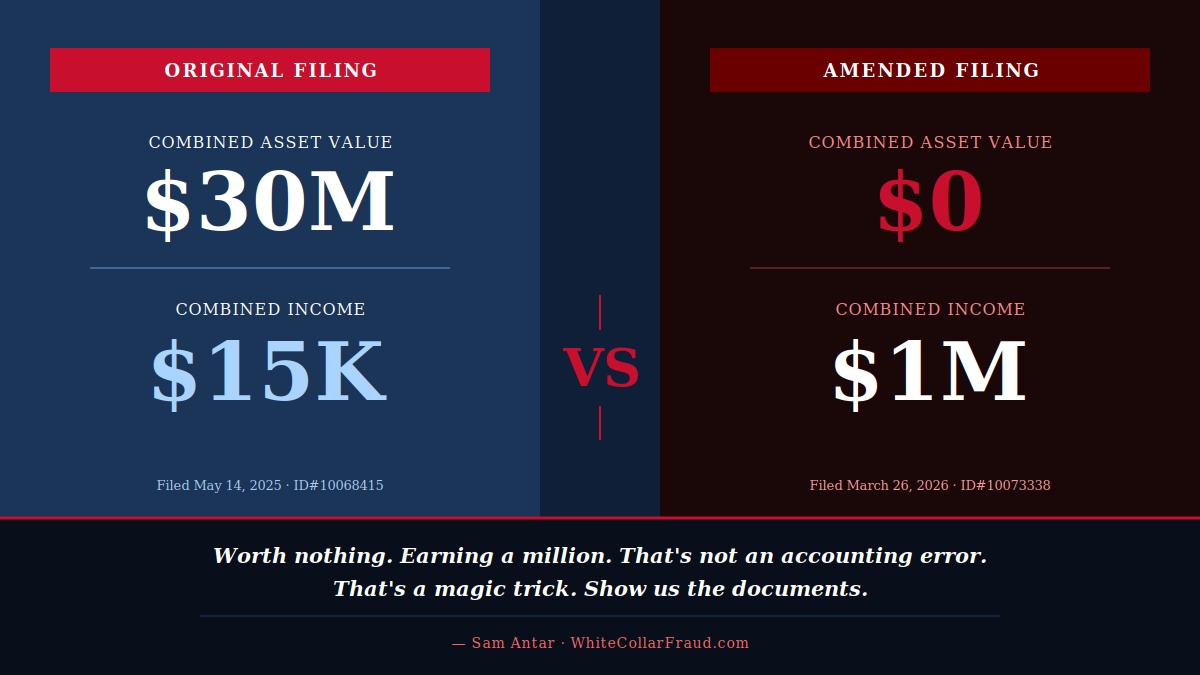
The broad outline of Rep. Ilhan Omar’s financial disclosure situation has been widely reported. Her original 2024 filing listed businesses co-owned by her husband, Timothy Mynett, at a combined value of up to $30 million. An amended filing reduced that figure to zero. Her office says an accounting error explains the difference. The winery at the center of the story, eStCru, dissolved nine days after the amendment was filed.
Journalists have covered the chronology accurately. What has not been done — because it requires reading the numbers the way an accountant reads them, not the way a headline writer does — is the forensic analysis.
When I read these disclosures as a forensic accountant, I find anomalies that the “accounting error” explanation does not address. I am going to walk through each one with the precision the documents require.
All figures in this analysis are drawn directly from official House Clerk financial disclosure PDFs, the House Oversight Committee’s February 5, 2026 letter to Timothy Mynett, and sourced investigative reporting from the Minnesota Reformer, Wall Street Journal, Washington Free Beacon, and Dallas Express. Every claim is linked to its source. I do not rely on anonymous sources for the accounting conclusions in this report. Where I draw inferences, I say so explicitly.
What the Documents Show
I have compiled and verified every Schedule A entry from Rep. Omar’s seven financial disclosure filings spanning 2019 through 2024, cross-referenced line by line against the official House Clerk PDFs. The table below transposes the key metrics for easy year-over-year comparison. Red-shaded cells flag the figures that require explanation.
TABLE 1 — Ilhan Omar Financial Disclosure Summary · All Figures Verified Against Official House Clerk PDFs
| Metric | 2019 Annual |
2020 Amend. |
2021 Annual |
2022 Annual |
2023 Annual |
2024 Original |
2024 Amended |
|---|---|---|---|---|---|---|---|
| Filing Date | 08/13/2020 | 11/04/2021 | 05/13/2022 | 05/15/2023 | 05/14/2024 | 05/14/2025 | 03/26/2026 |
| Total Assets — Low | $1,001 | $32,007 | $37,013 | $73,013 | $37,012 | $6,018,006 | $18,004 |
| Total Assets — High | $15,000 | $133,000 | $209,000 | $273,000 | $208,000 | $30,095,000 | $95,000 |
| ESTCRU Value — Low | — | $15,001 | $15,001 | $50,001 | $15,001 | $1,000,001 | None |
| ESTCRU Value — High | — | $50,000 | $50,000 | $100,000 | $50,000 | $5,000,000 | None |
| ESTCRU Income — Low | — | $0 | $0 | $0 | $201 | $5,001 | $2,501 |
| ESTCRU Income — High | — | $0 | $0 | $0 | $1,000 | $15,000 | $5,000 |
| Rose Lake Value — Low | — | — | — | $1 | $1 | $5,000,001 | None |
| Rose Lake Value — High | — | — | — | $1,000 | $1,000 | $25,000,000 | None |
| Rose Lake Income — Low | — | — | — | $0 | $15,001 | $0 | $100,001 |
| Rose Lake Income — High | — | — | — | $0 | $50,000 | $0 | $1,000,000 |
| Total Liabilities — Low | $15,001 | $25,001 | $30,002 | $45,003 | $45,003 | $30,002 | $30,002 |
| Total Liabilities — High | $50,000 | $65,000 | $100,000 | $150,000 | $150,000 | $100,000 | $100,000 |
| Net Worth — Low | -$48,999 | -$32,993 | -$62,987 | -$76,987 | -$112,988 | $5,918,006 | -$81,996 |
| Net Worth — High | -$1 | $107,999 | $178,998 | $227,997 | $162,997 | $30,064,998 | $64,998 |
Sources: 2019 Annual (ID#10036809) · 2020 Amend. (ID#10043918) · 2021 Annual (ID#10047039) · 2022 Annual (ID#10053193) · 2023 Annual (ID#10060937) · 2024 Original (ID#10068415) · 2024 Amended (ID#10073338)
Note: “Net worth” ranges are derived mechanically from disclosed asset and liability bands and are used for comparative purposes only. Congressional financial disclosures report values in broad ranges rather than exact figures. These calculations are not audited balance sheets.
Anomaly One: The Amendment Corrects Two Separate Categories Simultaneously — in Opposite Directions
This is the forensic anomaly that the “accounting error” explanation has not addressed. I raised this point publicly on Newsmax on April 20, 2026, five days before this report. The observation is now on the record: asset values collapsed while income rose, in the same amendment, for the same two entities. That does not reconcile without workpapers.
Rep. Omar’s office has described the original 2024 filing as an accounting error. Her spokeswoman said the filing was corrected “as soon as the discrepancy was identified.” Her lawyer wrote to the Office of Congressional Conduct that the error was “unfortunate” but that “nothing untoward and nothing illegal has occurred.”
The problem is not that an accounting error occurred. Accounting errors happen. The problem is what the amendment actually shows when you read it as an accountant. The amended filing does not correct one number. It reverses two separate categories simultaneously — and they move in opposite directions:
THE TWO-CATEGORY REVERSAL — DOCUMENTED FROM OFFICIAL FILINGS
| Item | 2024 Original Filed 05/14/2025 |
2024 Amended Filed 03/26/2026 |
Net Change |
|---|---|---|---|
| ESTCRU Value | $1,000,001–$5,000,000 | None ($0) | ↓ Down up to $5M |
| ESTCRU Income | $5,001–$15,000 | $2,501–$5,000 | Revised |
| Rose Lake Value | $5,000,001–$25,000,000 | None ($0) | ↓ Down up to $25M |
| Rose Lake Income | None ($0) | $100,001–$1,000,000 | ↑ UP $1M |
| Combined Assets | Up to $30,000,000 | $0 | ↓ DOWN $30M |
| Combined Income | Up to $15,000 | Up to $1,005,000 | ↑ UP $990,000 |
Asset valuation and income are reported on different lines of Schedule A. They derive from different source documents. Asset valuation for a partnership interest reflects the member’s equity in the entity — it comes from a capital account statement or valuation analysis. Income reflects the partner’s allocated share of partnership profits — it comes from a K-1. These are not the same number. They are not calculated the same way. They are not produced by the same document.
Calling a two-category reversal in opposite directions an “accounting error” is not an explanation. It is a label. An error that inflates asset values does not automatically suppress income. An error that suppresses income does not automatically inflate asset values. These are independent calculations requiring independent corrections.
This is not a simple “oops, wrong number” situation. The corrected filing creates a new problem. The same two businesses went from being worth up to $30 million to being worth zero — while the amended filing simultaneously reported income from those same entities, and supporting reporting identified a distribution to Mynett from at least one of them. Worth nothing. Reporting income. Distributing value. That does not reconcile without workpapers.
— S.E. Antar
I am not saying that is impossible. I am saying it has not been explained. And in forensic accounting, an unexplained reconciliation item does not get labeled “error” and closed. It gets documented and answered.
Anomaly Two: The Liability Explanation Is Unsupported in the Public Record
The central factual claim underlying the amended filing is that liabilities against the businesses wiped out the net values of eStCru and Rose Lake Capital entirely. This claim has been accepted at face value by every reporter covering the story. I do not accept claims at face value. I follow the math.
The Wall Street Journal reported that a 2025 email between Mynett and his accountant valued eStCru at $1.5 million and Rose Lake Capital at $7.9 million, with Mynett owning roughly one-third of each entity. I will use those figures as my starting point — not because I verified them independently, but because they are Omar’s own accountant’s numbers, produced in response to a congressional ethics inquiry.
LIABILITY GAP CALCULATION — USING OMAR’S OWN ACCOUNTANT’S FIGURES
| Item | Amount |
|---|---|
| Accountant’s 2025 Valuations — per Wall Street Journal | |
| eStCru total value (accountant’s estimate) | $1,500,000 |
| Rose Lake Capital total value (accountant’s estimate) | $7,900,000 |
| Mynett’s ownership share (per WSJ reporting) | ~33.3% of each |
| Mynett’s Estimated Share | |
| eStCru (~1/3 of $1.5M) | ~$500,000 |
| Rose Lake Capital (~1/3 of $7.9M) | ~$2,633,000 |
| Combined Mynett Share | ~$3,133,000 |
| Disclosed Personal Liabilities — 2024 Amended, ID#10073338 | |
| Nelnet student loans (max of disclosed range) | $50,000 |
| Citi Bank credit card (max of disclosed range) | $50,000 |
| Maximum Disclosed Liabilities | $100,000 |
| Unidentified Liability Gap Required to Reconcile to Zero | ~$3,033,000+ |
I want to be precise about what this means legally. Entity-level LLC liabilities — business debts, credit facilities, obligations to investors — are not required to appear as personal liabilities on Schedule D of a House financial disclosure. So the absence of those liabilities from Schedule D is not by itself a disclosure violation.
But the amended filing does not identify those liabilities anywhere. It does not name the creditors, characterize the terms, or explain whether the obligations are entity-level or personally guaranteed, recourse or non-recourse, contingent or fixed. The central explanation for a dramatic financial disclosure revision is supported by nothing in any public document.
Before going further, a critical distinction: income and distributions are not the same thing. Income is your allocated share of partnership profits — it flows through to your tax return via a K-1 whether or not you receive anything. A distribution is actual cash or something else of value — property, assets, or other consideration — transferred out of the entity to the partner. They are reported separately. They are calculated separately. One is a paper entry. The other is something of real value that physically leaves the entity.
The amended filing — and the Wall Street Journal’s reporting on supporting documentation — reflects both income allocations and at least one distribution. The same entities that were simultaneously reduced to zero value were reporting income allocations, and WSJ reporting identified a distribution to Mynett from at least one of them. That is the forensic anomaly the amendment creates and does not resolve.
Here is why that matters: creditors with senior claims on a distressed entity ordinarily have priority over equity partners receiving distributions of cash or other value. If distributions occurred while liabilities supposedly wiped out the equity value, the public record needs to reconcile that sequence. If more than $3 million in liabilities exist against Mynett’s ownership interests — as the amendment’s own math requires — the public record does not explain how distributions of cash or other value flowed to the equity partner while unidentified creditors holding over $3 million in claims went unaddressed. That requires the K-1s, the capital account schedules, the creditor schedules, and the distribution records.
Anomaly Three: Five Entities, One Structural Signature, Six Years
Journalists have focused almost entirely on eStCru and Rose Lake Capital. That is understandable — those are the entities at the center of the 2024 filing. But it misses something important that only becomes visible when you read all seven filings in sequence as a forensic accountant.
The same structural anomaly — income disconnected from or disproportionate to disclosed asset value — appears across five separate Mynett business entities over six consecutive disclosure years. This is not one filing that looks unusual. It is a pattern.
PATTERN DOCUMENTATION — FIVE MYNETT ENTITIES ACROSS SIX DISCLOSURE YEARS
E Street Group (2020 & 2021): Disclosed value: $1–$1,000 both years. Disclosed income: $100,001–$1,000,000 both years. The political consulting firm Omar’s campaign paid approximately $2.78 million for consulting services. Disclosed as worth essentially nothing while reporting up to one million dollars per year in partnership income for two consecutive years.
ESTREETCO LLC (2020 & 2021): Disclosed value: $1–$1,000. Disclosed income: $5,001–$15,000. Same structural signature. Disappeared from the disclosures after 2021 with no Schedule B transaction entry.
EstVenture LLC (2021 & 2022): 2021 — value $1–$1,000, income $5,001–$15,000. 2022 — value None, income $15,001–$50,000. Income rising as the value disappeared entirely. Vanished from the disclosures after 2022 with no Schedule B transaction entry.
ESTCRU LLC (2020–2024): Zero income for three consecutive years. Then rising income as value surged to $1–$5 million. Then zeroed out in the amendment — while the entity had $650 in its bank account and was defending a $780,000 lawsuit.
Rose Lake Capital LLC (2022–2024): 2022: value $1–$1,000, no income. 2023: value $1–$1,000, income $15,001–$50,000. 2024 original: value $5–$25 million. 2024 amended: value zero, income up to $1 million.
Three of these five entities — E Street Group, ESTREETCO, and EstVenture — disappeared from Rep. Omar’s financial disclosures without any corresponding Schedule B entries reflecting a reportable sale, exchange, or disposition exceeding $1,000. House financial disclosure instructions require Schedule B reporting for the purchase, sale, or exchange of most Schedule A assets when the transaction exceeded $1,000. (See House Committee on Ethics — 2024 Financial Disclosure Instruction Guide.) I reviewed every Schedule B in every filing. The only entries across six years of disclosures are four Guideline 401(k) fund sales on April 14, 2023. No Schedule B entries for any Mynett business entity appear in any filing, across any year.
Anomaly Four: The Winery That Wasn’t There
To understand why a $650 bank balance sitting alongside a $1–$5 million valuation matters, you need the full operational picture of eStCru. When you assemble it from primary sources, the picture is striking.
In fall 2021, Mynett and his business partner William Hailer solicited a $300,000 investment from Naeem Mohd, a Washington, D.C.-area restaurant owner. According to the investment contract, reviewed and reported by the Minnesota Reformer, the terms were: Mohd would receive a 200% return — $900,000 — within 18 months. If that payment was not made on time, Mynett and Hailer would owe 10% monthly interest on any outstanding balance. For context: 10% monthly interest equates to 120% per annum — a rate that would raise obvious usury questions under California law unless an exemption applied.
The 18 months came and went. Mohd did not receive his $900,000. Mynett and Hailer returned his $300,000 principal approximately one month late — and never paid the promised interest. Mohd sued in fall 2023, seeking $780,000. The lawsuit alleged Mynett and Hailer had “fraudulently misrepresented … that eStCru, LLC was a legitimate company.” Mynett and Hailer deny the fraud allegation. Mohd’s attorney confirmed to the Washington Free Beacon the case was resolved with the winery paying a cash settlement in November 2024.
The Mohd lawsuit was not eStCru’s only litigation. In April 2023, three of Hailer and Mynett’s other companies agreed to pay $1.7 million to settle a separate South Dakota lawsuit alleging fraud and breach of contract. April 2023 is also when Erica Stancliff, the respected Sonoma winemaker eStCru had hired, stopped getting paid. Stancliff told the Minnesota Reformer: “It happened very abruptly. I couldn’t even tell you exactly how it happened other than we hit a wall and the reserve was no longer there.”
So in April 2023: the winemaker was not being paid. The $900,000 owed to Mohd was overdue. A $1.7 million settlement was being reached in South Dakota. The winery’s reported disclosure value for that year: $15,001–$50,000, with income of $201–$1,000. By 2024, court records showed eStCru had $650 in its bank account. In the same reporting year, the original 2024 disclosure valued the entity at $1,000,001–$5,000,000.
A $650 bank balance alongside a $1–$5 million valuation demands documentation — a balance sheet, valuation workpapers, and a creditor schedule that reconcile those numbers. Those documents are not in the public record.
Independent journalist Angela Rose visited the Santa Rosa, California address listed on every Omar disclosure from 2021 through 2024. As reported by the Dallas Express, she found a letter from Punchdown Cellars, the building operator, stating that eStCru had not been a client there for several years. The address on six consecutive federal financial disclosures was an address where the business had already ceased operations.
Anomaly Five: The Venture Capital Firm That Claimed $60 Billion
The House Oversight Committee’s February 5, 2026 letter to Mynett confirms that the Rose Lake Capital website claimed the firm was “staffed by five former diplomats who have experience in over 80 countries and involvement in 11 free trade agreements,” and that an earlier version of the website identified Mynett as co-founder and listed former U.S. ambassadors and Members of Congress as advisors. According to reporting by the New York Post, that version also promoted $60 billion in assets under management. The Comer letter confirms all of this information was subsequently removed from the website.
The New York Post identified the scrubbed names as former Obama Ambassador to Bahrain Adam Ereli, former Sen. and Ambassador to China Max Baucus, DNC Finance Chair associate Alex Hoffman, former DNC Treasurer William Derrough, and former Amalgamated Bank CEO Keith Mestrich. None of these individuals has been charged with any wrongdoing. Baucus himself told the New York Post: “You can read between the lines — it sounded a little bit fishy.” When a former Democratic senator volunteers that a fellow Democrat’s business dealings sound off, the remark lands harder than any opposition research.
When I see a firm claiming $60 billion in assets under management, I look for its regulatory footprint. A firm publicly claiming $60 billion in assets under management should leave a regulatory footprint — an SEC adviser registration, an exempt-reporting-adviser filing, a state filing, or a clearly identified exemption. The Washington Free Beacon confirmed that Rose Lake Capital is not registered with the SEC. A search of the SEC’s Investment Adviser Public Disclosure database returns no results for the firm. Whatever the applicable exemption, if any, that regulatory absence has not been publicly explained.
Nine Days
- Fall 2021
Mynett and Hailer solicit $300,000 from Naeem Mohd under a contract promising $900,000 return in 18 months plus 10% monthly interest for late payment. - April 2023
Winemaker Erica Stancliff stops getting paid. The $900,000 owed to Mohd is overdue. Three Hailer-Mynett companies agree to pay $1.7 million to settle South Dakota lawsuit. - Fall 2023
Mohd sues eStCru seeking $780,000, alleging the pair “fraudulently misrepresented … that eStCru, LLC was a legitimate company.” Mynett and Hailer deny the allegation. - February 2024
Court records show eStCru has $650 in its bank account. Rose Lake Capital has $42.44. - September–October 2024
Rose Lake Capital removes names of nine officers and advisors from its website, including former ambassadors and Democratic Party officials. Confirmed in House Oversight Committee letter. - November 2024
Mohd v. eStCru settled. Mohd’s attorney confirmed to the Washington Free Beacon the winery paid a cash settlement. - May 14, 2025
Omar files 2024 annual disclosure. ESTCRU valued $1M–$5M. Rose Lake valued $5M–$25M. Combined household assets up to $30 million. Combined income from both entities: $5,001–$15,000. - February 5, 2026
House Oversight Chairman James Comer writes to Mynett requesting financial records, SEC filings, and documents related to travel to the UAE, Somalia, and Kenya. The letter notes the jump from $51,000 in 2023 to $30 million in 2024 raises “concerns that unknown individuals may be investing to gain influence with your wife.” - March 2026
Office of Congressional Conduct contacts Omar’s office. Omar’s spokesperson says the filing was corrected “as soon as the discrepancy was identified.” The public chronology reported by the Wall Street Journal shows the amendment came after the OCC’s contact, not before it. - March 26, 2026
Amended disclosure filed. ESTCRU and Rose Lake zeroed. Household assets: $18,004–$95,000. Income from those same entities: up to $1,005,000. - April 4, 2026
eStCru LLC formally dissolved under California law, signed by William Hailer. Nine days after the amendment. The Comer document request for financial records remained pending.
Businesses dissolve for legitimate reasons. What the dissolution does, in this specific context, is complicate the documentary record. The winding-up documents, the disposition of remaining assets and liabilities, the final accounting — those are records of a dissolved entity. Investigators pursuing subpoenas should move to secure that paper trail before it becomes harder to compel.
The Questions the Public Record Cannot Answer
- What is the specific accounting mechanism by which a single error simultaneously inflated asset values by up to $30 million and suppressed income by up to $990,000, on two separate Schedule A lines, for two separate entities? The workpapers that generated both the original and amended figures should answer this question directly.
- What specific liabilities, owed to which creditors, on what terms, reduced Mynett’s combined ~$3.1 million ownership interest to zero? Were they entity-level, recourse, non-recourse, contingent, or personally guaranteed? These facts are the entire foundation of the amendment’s explanation and they appear in no public document.
- If liabilities exceeding $3 million exist against Mynett’s ownership interests, how does the public record reconcile that with the amended filing’s reported income allocations and distributions of cash or other value from the same entities? Income and distributions are not the same thing — income is an allocated K-1 entry, a distribution is actual cash or something else of value transferred out of the entity to the partner. The amended filing and supporting documentation reflect both. Creditors with senior claims ordinarily have priority over equity partners receiving distributions of cash or other value. The K-1s, capital account schedules, creditor schedules, and distribution records would answer this question.
- What were the full terms of the November 2024 cash settlement of the Mohd lawsuit? The original obligation was $780,000 plus accrued 10% monthly interest. Was the settlement amount reportable income on the 2024 disclosure?
- What happened to E Street Group, ESTREETCO LLC, and EstVenture LLC? House financial disclosure instructions require Schedule B reporting for the purchase, sale, or exchange of most Schedule A assets when the transaction exceeded $1,000. (See House Committee on Ethics — 2024 Financial Disclosure Instruction Guide.) If any of these entities was sold, exchanged, or otherwise disposed of through a reportable transaction exceeding $1,000, Schedule B is where that transaction should appear. No such entries appear in any filing I reviewed across six years of disclosures.
- How did Rose Lake Capital, with $42.44 in its bank account in February 2024 and a disclosed value of $1–$1,000 in 2023, reach a reported valuation of $5–$25 million in 2024? What investor capital flowed in, from whom, and on what terms?
- Rose Lake Capital claimed $60 billion in assets under management on its public website. The Washington Free Beacon confirmed it is not registered with the SEC. A search of the SEC’s Investment Adviser Public Disclosure database returns no results. A firm of its claimed scale should have a clear regulatory footprint — an SEC registration, an exempt-reporting-adviser filing, a state filing, or an identified exemption. Which applies here, and where is it documented?
- Why were nine named officers and advisors — including former ambassadors and Democratic Party officials — removed from the Rose Lake Capital website in fall 2024 as investigations intensified? Were those associations accurate when listed?
- What records did the Comer document request produce regarding travel to the UAE, Somalia, and Kenya? Has Mynett responded to the Committee?
- What assets and liabilities were transferred or extinguished in the April 4 dissolution of eStCru? To whom were remaining assets distributed? What happened to the intellectual property and trademarks Mynett and Hailer said they were attempting to sell?
What the Documents Establish
I have spent 30 years teaching federal investigators how to read financial documents. The first principle is the difference between what you can prove and what you suspect. Documented anomalies subjected to rigorous forensic analysis are evidence. Everything else is opinion. Here is what the documents establish, without qualification:
The amendment reversed two independent categories simultaneously in opposite directions. Asset values collapsed while income rose, for the same two entities, in the same filing. Verifiable by anyone who reads the original and the amendment side by side.
The liability explanation requires more than $3 million in liabilities or valuation offsets that are not identified in any public document. That arithmetic uses Omar’s own accountant’s numbers, as reported by the Wall Street Journal. The same amended filing that zeroed the asset values simultaneously reported income allocations from those same entities, while supporting reporting identified at least one distribution of cash or other value to Mynett. Income and distributions are not the same thing. One is a K-1 paper entry. The other is actual cash or something else of value that physically left the entity. Both require explanation against a backdrop of more than $3 million in unidentified liabilities.
Five Mynett entities displayed the same structural disconnect between disclosed value and disclosed income across six years. Three disappeared from the disclosures without any corresponding Schedule B entries reflecting a reportable sale, exchange, or disposition exceeding $1,000.
eStCru had $650 in its bank account, its winemaker had left after unpaid invoices, and it was defending a $780,000 lawsuit, during the same period it was disclosed at $1–$5 million in value. A $1.7 million settlement in a separate Hailer-Mynett lawsuit was reached in April 2023, the same month the winemaker stopped getting paid. All confirmed in Minnesota Reformer reporting.
Rose Lake Capital claimed $60 billion in AUM, operated from a WeWork office, was disclosed at $1–$1,000 in 2023, and is not registered with the SEC. Confirmed by the Washington Free Beacon. Former Senator Max Baucus, listed as an advisor, told the New York Post it “sounded a little bit fishy.”
The Rose Lake Capital website was scrubbed of named officers and advisors during an investigation. Confirmed in the Comer letter as a primary source.
The amendment followed contact from the Office of Congressional Conduct, not a voluntary internal discovery. The public chronology documents this sequence.
eStCru was dissolved nine days after the amendment while a congressional document request remained pending. Confirmed by the Washington Free Beacon from California business records.
What the documents do not yet establish — because the necessary records are not public — is why. That is what investigators with subpoena power are for.
Documents don’t lie. People lie about documents. The documents here are speaking clearly. The question is whether anyone with subpoena power is listening.
— S.E. Antar
I will update this analysis as new documents become available. If I am wrong about any factual claim in this report, I will correct it publicly and promptly. That is the standard I hold myself to. It should be the standard applied to everyone involved in this matter.
Written by Sam Antar | Forensic Accountant & Fraud Investigator
© 2026 Sam Antar. All rights reserved.
Disclosure: I am a former felon who committed securities fraud at Crazy Eddie before cooperating with federal authorities. I have spent over 30 years as a consultant and educator on fraud detection for the FBI, SEC, DOJ, and other law enforcement agencies. This analysis is based exclusively on public records and sourced reporting. Nothing in this report constitutes a legal conclusion. Where I characterize something as a documented fact, I have linked to its primary source. Where I draw an inference, I have said so explicitly. Mynett and Hailer deny the fraud allegations in the Mohd lawsuit. None of the individuals named as former Rose Lake Capital advisors have been charged with any wrongdoing.
Primary Source Documents
2019 Annual Disclosure (ID#10036809)
2020 Amendment (ID#10043918)
2021 Annual Disclosure (ID#10047039)
2022 Annual Disclosure (ID#10053193)
2023 Annual Disclosure (ID#10060937)
2024 Original Annual Disclosure (ID#10068415)
2024 Amended Disclosure (ID#10073338)
House Oversight Committee Letter to Mynett (Feb. 5, 2026)
House Oversight Committee Press Release (Feb. 6, 2026)
Key Investigative Sources
Minnesota Reformer — eStCru investor lawsuit (June 5, 2024)
Wall Street Journal — accountant email and OCC letter
Washington Free Beacon — eStCru dissolution and SEC non-registration (April 2026)
New York Post — Rose Lake Capital website scrubbing (December 27, 2025)
Dallas Express — eStCru dissolution (April 22, 2026)
Angela Rose — Punchdown Cellars visit (February 4, 2026)
SEC Investment Adviser Public Disclosure Database