Molly Roberts says grand jurors were “reading the news.” She’s right. That news was built by 53 federal crimes – and a federal judge just documented the latest one with timestamps.
On Friday, Lawfare published Molly Roberts’s analysis of the failed Letitia James indictments. Buried in her conclusion was an admission she didn’t realize she was making:
“Grand jurors have been reading the news… The grand jury—aware of President Trump’s efforts to punish a political opponent come hell, high water, or dismissal on the basis of improper appointment—may have thought along the same lines.”
That’s not analysis. That’s an admission the jury pool was poisoned.
What Roberts doesn’t mention is where that news came from – or that a federal judge documented the latest leak with timestamps.
Since December 1, I’ve documented 53 instances of DOJ insiders illegally leaking non-public information to journalists in the Letitia James case. Grand jury proceedings. Witness interviews. Internal deliberations. Personnel decisions. Prosecution strategy. Every leak helped the defendant. Not one helped the prosecution.
The “news” that grand jurors read wasn’t journalism. It was a coordinated obstruction campaign built on federal crimes.
Roberts just confirmed it worked.
The Crime a Federal Judge Documented
On December 11, ABC News published that the grand jury declined to indict Letitia James. The timestamp on the article: 4:06 PM. (Click on any image to enlarge.)
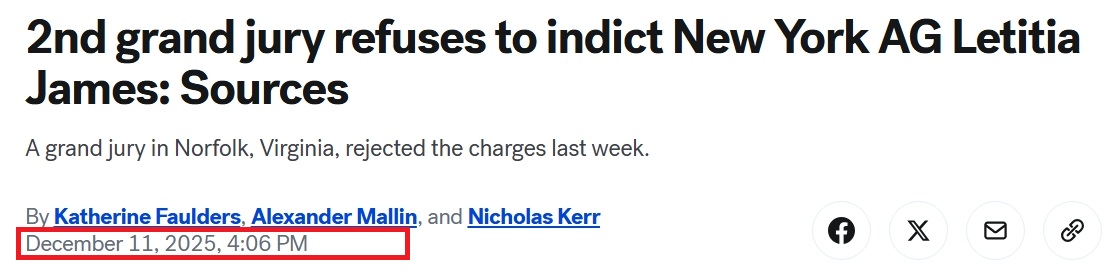
The grand jury didn’t return the no-bill in open court until 4:39 PM.
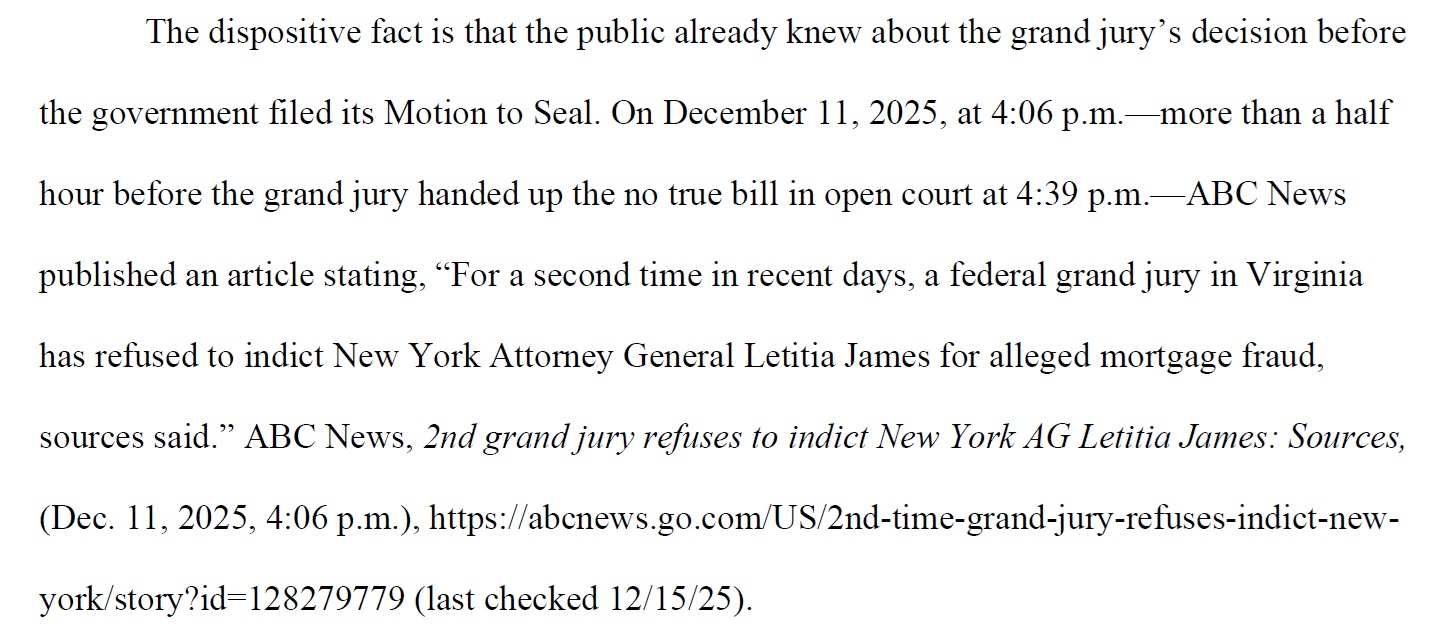
The media reported the verdict 33 minutes before it was officially returned in open court.
Magistrate Judge William Porter documented both timestamps in his order. Grand jury proceedings are secret under Federal Rule of Criminal Procedure 6(e). Unauthorized disclosure is a federal crime.
A federal judge put the timestamps in the public record. Someone with access to protected grand jury information was feeding reporters in real time.
Roberts wrote 2,000 words analyzing why the prosecution “keeps failing.” She didn’t mention the federal crime documented with timestamps in the court record.
That’s not an oversight. That’s the tell.
The Statement That Was Already Written
The ABC article published at 4:06 PM didn’t just report the result. It included a polished statement from James’s attorney, Abbe Lowell:
“This unprecedented rejection makes even clearer that this case should never have seen the light of day. Career prosecutors who knew better refused to bring it, and now two different grand juries in two different cities have refused to allow these baseless charges to be brought. Any further attempt to revive these discredited charges would be a mockery of our system of justice.”
That’s not a quick reaction. That’s lawyered language – “unprecedented rejection,” “mockery of our system of justice,” “two different grand juries in two different cities.”
Lowell had his victory statement written, sent to reporters, and published – 33 minutes before the grand jury returned its decision in open court.
Someone told him too.
How the Jury Pool Was Poisoned
Between September 17 and December 17, 2025, nine newsrooms published stories built on illegal leaks from DOJ insiders. The message was consistent: the evidence is weak, the case is political, career prosecutors declined to charge.
That wasn’t reporting. It was narrative construction.
September 17: ABC and CNN publish nearly identical stories. Both claim career prosecutors found “insufficient evidence.” Both cite anonymous sources “speaking on condition of anonymity to discuss non-public investigations.”
September 19: Reuters, The New York Times, and Washington Post join with more details – internal deliberations, personnel decisions, prosecutorial conclusions that had never been officially released.
October 9: Lindsey Halligan presents to a grand jury. Indictment on all counts. Same day, ABC reports that Bondi and Blanche were “caught off guard.” Another leak positioning leadership as blindsided by their own prosecution.
The pattern continued for three months. Leak after leak. Story after story. All building the same narrative: this is Trump’s vendetta, the evidence doesn’t exist, anyone who prosecutes is a political hack.
By the time Roger Keller presented to grand juries in December, the jury pool had been saturated. Every potential juror had read the “news.” Every potential juror “knew” this was political retribution.
It wasn’t just Lawfare noticing. The New York Times reported on December 13 that DOJ officials “groused about anti-Trump bias among jurors.” They knew the jury pool was hostile. They knew the media narrative had taken hold. They complained about the bias – while their own leaks were feeding it.
Roberts treats this as neutral background. “Grand jurors have been reading the news.”
She doesn’t ask who wrote that news. She doesn’t ask who leaked the information that made it possible. She doesn’t ask whether poisoning a jury pool with illegal disclosures constitutes obstruction of justice.
She just cites the result as evidence the case was weak.
That’s not legal analysis. That’s the obstruction working exactly as designed.
The Prosecutor Who Wasn’t There
Roberts asks why Roger Keller couldn’t do what Lindsey Halligan did. She offers theories about the indictment’s legal weaknesses and “random variance in the grand jury pool.”
She doesn’t mention that Keller wasn’t in the courtroom when the grand jury returned its decision.
Judge Porter noted it in the first paragraph of his order: “The Assistant United States Attorney who signed the draft indictment did not appear for the hearing.”
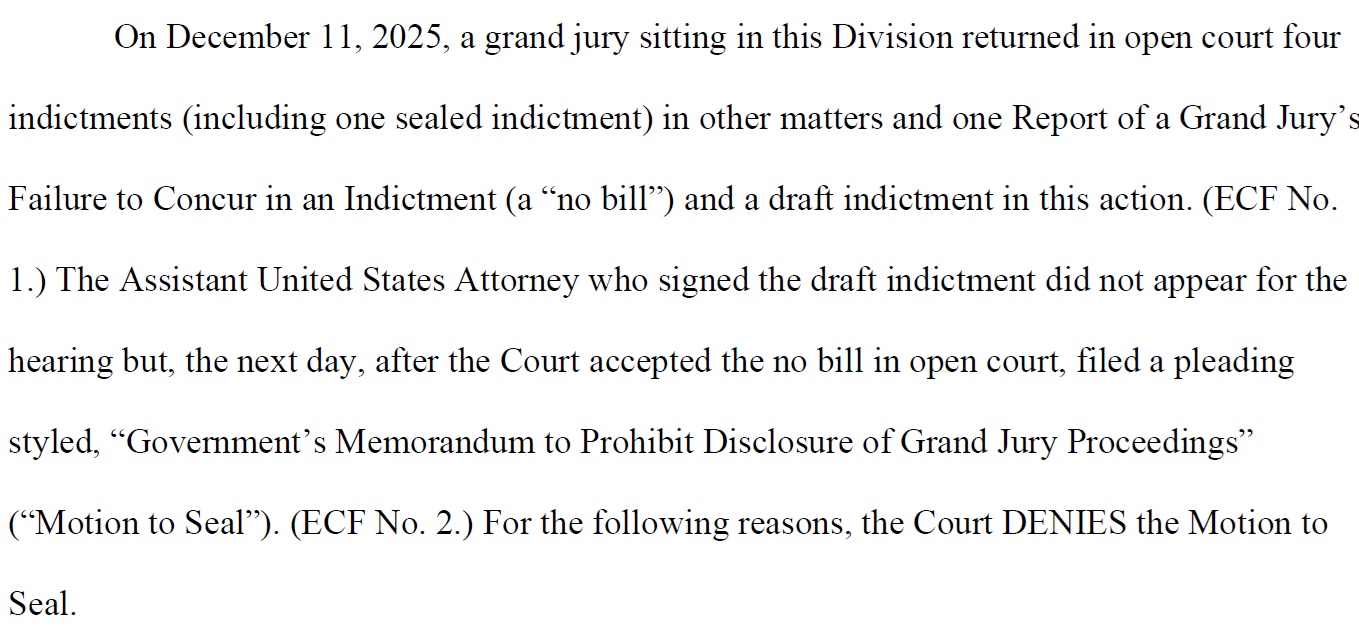
The prosecutor who signed the indictment wasn’t present when the foreperson delivered the decision to the court.
Why wasn’t Keller there?
Did he know the outcome? Was he told not to attend? Was he indifferent?
Roberts doesn’t ask. She doesn’t mention that Keller’s last criminal case was in 2011. That he spent 14 years handling civil litigation. That he admitted at arraignment he was still “going through the discovery.” That he presented to two grand juries in seven days over the holidays.
She analyzes the indictment as if it was presented by prosecutors trying to win.
She never considers the possibility it was presented by a civil lawyer set up to fail.
What Roberts Analyzed
Roberts spends 2,000 words on the legal technicalities of the Peronne Avenue charges. She examines the Second Home Rider. She parses Fannie Mae guidelines. She questions whether “occupancy” was sufficiently defined.
It reads like legal analysis. It’s a defense press release.
Roberts ignores what I documented in October: James made four contradictory sworn statements about the same property to four different institutions.
To the bank: “Second home” for personal use.
To the insurance company: “Owner-occupied.”
To the IRS: “Rental property” with “zero personal use days.”
To New York State: “Investment.”
All four statements cannot simultaneously be true. At least three are lies. That’s not “squishy guidelines.” That’s systematic fraud – telling each institution exactly what they wanted to hear to maximize financial benefits.
Roberts doesn’t mention it. Just like Lawfare didn’t mention it when I called them out in October. Because acknowledging four contradictory sworn statements destroys the “weak case” narrative.
You don’t analyze a boxing match by studying the loser’s technique if the fight was fixed.
What Roberts Didn’t Mention
Roberts focuses exclusively on Peronne Avenue – the only property charged so far. She treats it as if that’s the entire case.
It’s not. Pattern evidence exists across three other properties spanning 40 years. Roberts ignores all of it.
Brooklyn (296 Lafayette Avenue): Twenty years of false unit counts to qualify for residential financing. Five units. James claimed four. In 2011, she obtained a federal HAMP loan modification – a program that explicitly excludes buildings with five or more units. The savings from two decades of favorable residential rates and federal HAMP assistance dwarf the Norfolk charges.
Sterling Street (Norfolk): Fifteen days before signing a sworn declaration that it would be her primary residence, James emailed confirming it “WILL NOT be my primary residence.”
Queens (1983): Mortgage documents identifying her father as her husband.
Four properties. Forty years. A documented pattern of mortgage fraud exposed through public records anyone can verify.
Pattern evidence matters. It proves intent. It destroys the “innocent mistake” defense. A prosecutor building a real case would use it. Roberts doesn’t mention it exists.
She doesn’t mention the contradictory sworn statements about Peronne – “second home” to the bank, “investment property” on state disclosures, “rental property” with “zero personal use days” on tax returns. Three sworn statements about the same property. At least two are lies.
She doesn’t mention the text message. On March 28, 2024, James texted her accountant: “I do not want to take deduction. It looks suspicious.” DOJ revealed this in their November 20 response to James’s motion to dismiss – it’s in the court record.
Four years of claiming deductions before she realized it “looks suspicious.” Consciousness of guilt in her own words – documented in a federal court filing.
Roberts wrote 2,000 words and didn’t address a single document I’ve published.
The Laundering Pipeline
Here’s how the narrative Roberts repeats was constructed:
DOJ insiders illegally leak to reporters. Reporters publish stories citing “anonymous sources.” Defense attorneys cite those stories in court filings. Amicus briefs repeat the leaked claims as established fact. Congressional Democrats cite the media reports in official letters. Legal commentators cite all of the above as the “consensus view.” Grand jurors read the coverage and conclude the case is political.
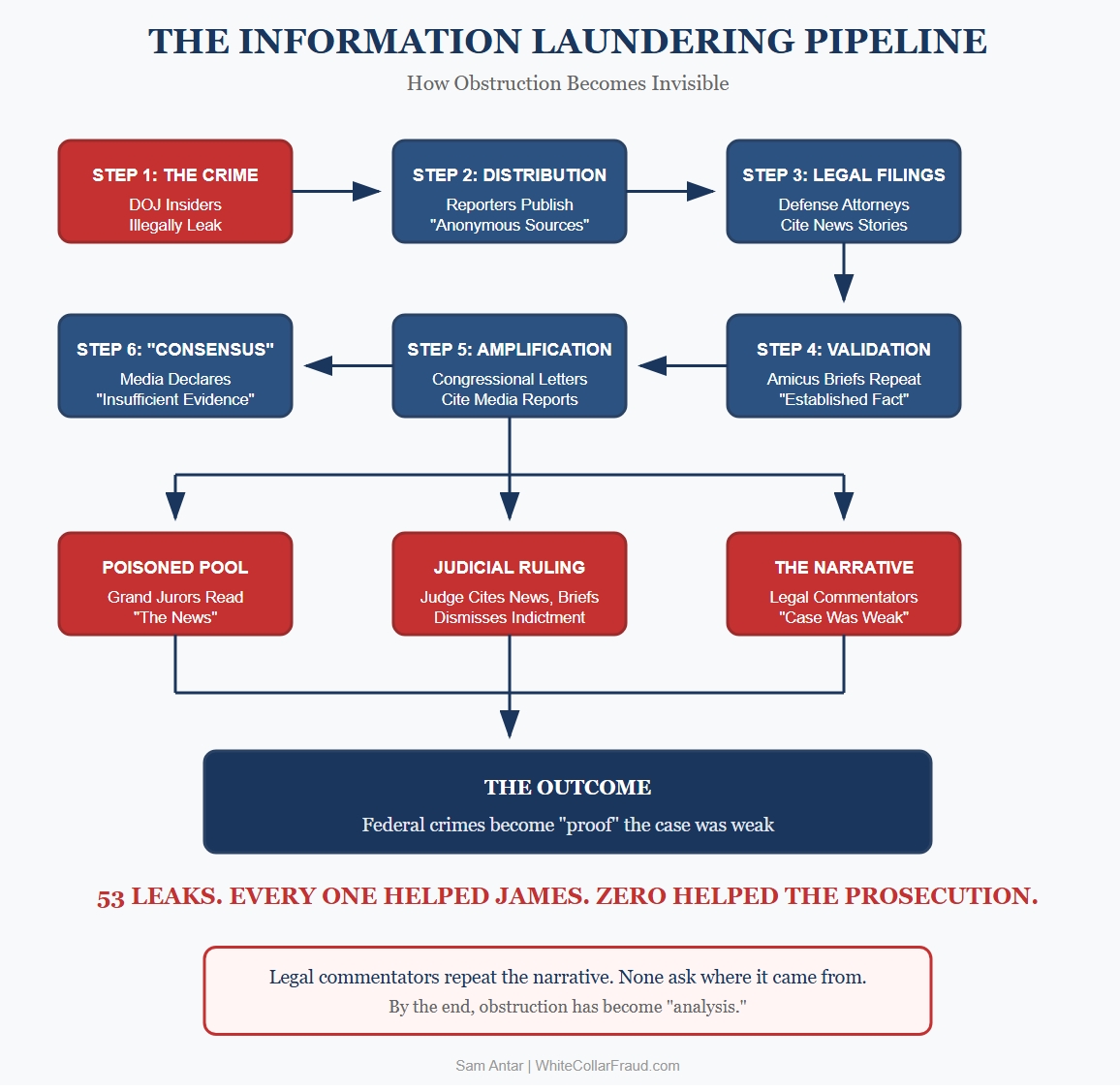
Roberts is the final step. She’s laundering obstruction into analysis.
She writes that “the case always was weaker but now the government is doing less to hide that weakness.”
No. The case was always strong. The documents haven’t changed. What changed is that 53 leaks created a public perception that made conviction impossible – and legal commentators are now citing that perception as proof the case lacked merit.
That’s not weak evidence. That’s successful obstruction.
The Same Blind Spot
Lawfare isn’t alone. On Thursday, National Review’s Andrew McCarthy published his own analysis. Same framing. Same conclusion. Same blind spot.
McCarthy calls the occupancy theory “even more obscure.” He repeats that the evidence was “too weak to indict.” He cites Siebert’s conclusion – the same conclusion that was illegally leaked to nine newsrooms in September.
He doesn’t mention the 33-minute leak. He doesn’t mention Keller’s absence. He doesn’t mention the other three properties. He doesn’t mention the 53 federal crimes that built the narrative he’s repeating.
Here’s the irony: McCarthy is a former federal prosecutor. He should be the first person asking why the AUSA wasn’t in the courtroom when the foreperson delivered the decision to the court. That’s a red flag any former DOJ attorney would recognize. McCarthy’s silence on that procedural anomaly is deafening.
Two publications. Opposite ends of the legal commentary spectrum. Both analyzing the indictment as if it was presented in good faith. Both treating the result as proof the case was weak. Both laundering obstruction into analysis.
Neither asking who obstructed it.
That’s not left versus right. That’s the cover-up working exactly as designed.
The Questions They Should Be Asking
Serious legal publications would ask:
Who leaked the grand jury result to ABC News 33 minutes before it was returned?
Why wasn’t the prosecutor in the courtroom when the foreperson delivered the decision?
Who assigned a civil lawyer with no criminal experience since 2011 to a high-profile fraud case?
Who set the December 4 and December 11 timeline – back to back, holiday season, rushed presentations?
Why have 53 leaks helped the defendant and zero helped the prosecution?
Is there an obstruction investigation? If not, why not?
Lawfare and National Review asked none of these questions. Instead, they published analyses that treat the obstruction as background noise and the result as proof the case was always weak.
That’s not legal scholarship. That’s the cover-up’s closing argument.
The Documents Don’t Disappear
Roberts concludes that “trying, trying again doesn’t always lead to success. Sometimes, it just leads to repeated failure.”
She’s describing the wrong failure.
The prosecution didn’t fail because the evidence was weak. It failed because 53 federal crimes poisoned the jury pool, a civil lawyer was installed to present it, and the timeline guaranteed inadequate preparation.
Grand juries come and go. Prosecutors rotate. Legal commentators publish their analyses and move on.
The documents don’t change.
Four properties. Forty years. Contradictory sworn statements that can’t all be true. A text message admitting it “looks suspicious.” A federal judge documenting a federal crime with timestamps. A prosecutor who wasn’t in the courtroom when the decision was returned.
No one has refuted a single document I’ve published. Not James. Not Lowell. Not the 53 leakers. Not Lawfare. Not National Review.
They analyze the technicalities. They repeat the narrative. They never address the evidence.
Because they can’t.
I’ll make them the same offer I’ve made everyone else: I’ll testify under oath. Same room. Full documentation. Molly Roberts and Andrew McCarthy can question me themselves.
Will they take it?
Sam Antar is a convicted felon and registered Democrat. As CFO of Crazy Eddie, he committed securities fraud in the 1980s. Since cooperating with federal authorities, he has spent over 30 years training law enforcement agencies including the FBI, SEC, IRS, and DOJ. He has never been paid or promised anything in return for this investigation. He follows the documents, not the politics.
Follow @SamAntar on X for updates.
Written by Sam Antar | Forensic Accountant & Fraud Investigator
© 2025 Sam Antar. All rights reserved.