Public records show $2.38 million in Hochul campaign refunds corresponding to gifts the state Democratic Party reported from the same donors. About $2.13 million was recorded by September 25, when the party made the first of two transfers totaling $16.5 million to Hochul. The records raise a question: did refunded contributions help fund the campaign through the party?
New York lets an individual give a candidate for governor up to $18,000: $9,000 for the primary and $9,000 for the general election. But the primary half is available only when the candidate faces a contested primary. Kathy Hochul was unopposed. After the June primary, her campaign began reporting large batches of refunds.
Then something odd shows up in the records. Many of the donors who got refunds turned up almost immediately on the books of the New York State Democratic Party, giving the party the same amounts, usually the same day. Matching on name, street address and exact amount, $2.38 million in Hochul refunds line up with party contributions this way.
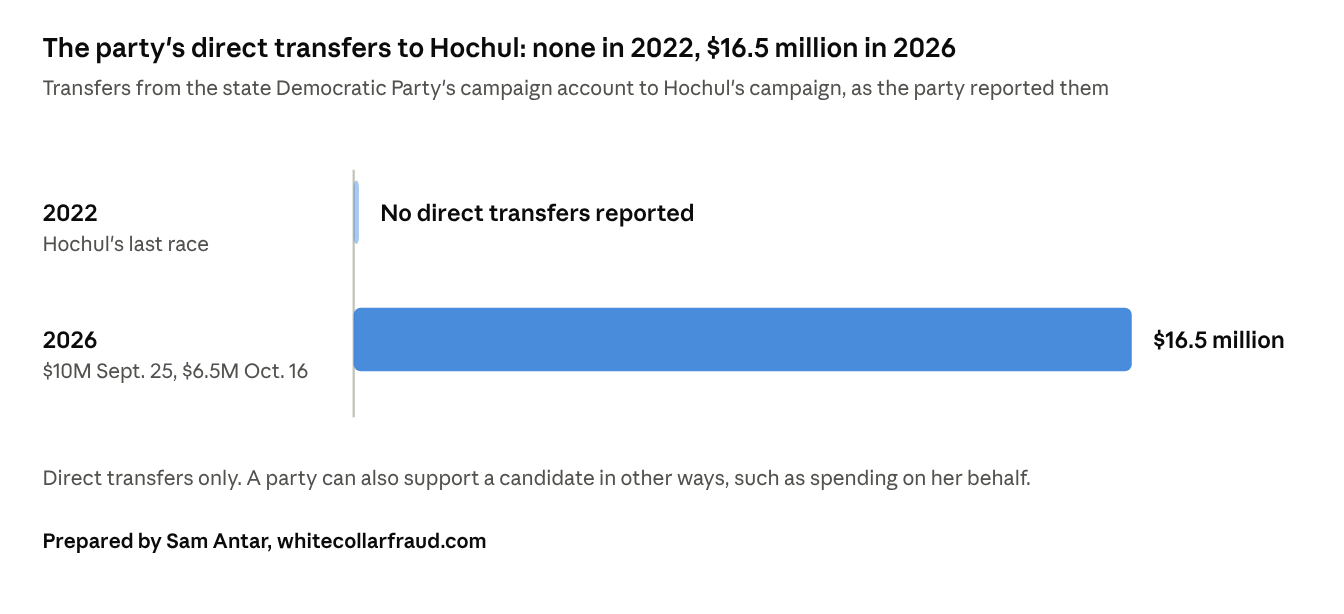
The party also sent Hochul’s campaign $16.5 million, 94% of everything it transferred to other campaigns and committees this year. In 2022, her last race, its state campaign account reported no direct transfers to her.
Follow what New York’s rules make possible. An individual can give Hochul $9,000 for the general election and can give the state party’s campaign account up to $138,600 a year. The party can give Hochul any amount. Line those rules up and a path appears: the campaign refunds a donor’s money, the donor gives it to the party, and the party sends money to the candidate. Each step, taken by itself, is a kind of transaction the rules allow; that does not settle whether these particular transactions were properly attributed or reported. The question is whether, taken together, they were separate decisions or one arrangement.
Taken together, the public records show each piece of that path, and several entries raise serious questions about a round trip: refunds and party gifts booked under the same check number, the party itself naming Hochul’s campaign as a source of money, and two donor PACs saying their refunds were redirected to the party. Hochul’s campaign itself has said it asked refunded donors to give to the party and gave those who agreed a form to send their refunds there. The missing link is proof that particular refunded dollars made it back to Hochul.
But a dollar-for-dollar trace may be the wrong test. Money is interchangeable, and paperwork can make each step look separate. Substance over form asks whether the refunds, the gifts and the transfers, taken together, worked as one arrangement. If they did, it would not matter which particular dollars came back. The records raise that question. Only the committees’ own records can answer it.
New York Focus first reported on October 15 that donors refunded by Hochul’s campaign were giving matching amounts to the party, and that the party sent her campaign $10 million. My investigation took that analysis substantially further, using the original filings: matching donors by name, street address and amount, examining the shared check numbers and the donor PACs’ own filings, identifying two equal sets of party receipts on October 19, and adding the second transfer of $6.5 million. I also rebuilt the party’s daily cash balance, compared its transfers to Hochul in 2022, and tested the refund pattern against three other campaigns.
The same tests found no such pattern for Hochul’s Republican opponent, Bruce Blakeman, or for Attorney General Letitia James and her Republican opponent, Saritha Komatireddy. Here is what the records do show, and what could settle it.
Why the primary matters
The Board of Elections’ handbook says a campaign gets a separate primary limit only if the candidate is “participating in a contested primary.” Hochul was unopposed on the Democratic line in the June 23 primary, so on that guidance she had one $9,000 limit per donor, not two.
In 2026, her campaign reported 1,935 refunds totaling $4.7 million, most of it in a dozen large batches after the primary. One donor, Molina Healthcare’s political action committee, gave the reason in its own filing: “No primary challenger.” Most refunds carry only the label “Contribution Refund.”
The refunds themselves aren’t the issue. The question is what happened to the money next.
The same donors, at the party
Refunds from nine of those batch dates correspond to party contributions from donors with the same names and amounts, usually recorded the same day or the next.
I counted only the matches that hold up on full name, street address, ZIP code and exact amount. Those total $2,376,625.36. About $521,000 more looks similar; to be conservative, I left it out.
The party recorded each of these as an ordinary contribution from the donor. None carries an explanation. Hochul’s campaign reported these as refunds paid to donors. Its reports show no payment to the party, but the party’s reports say otherwise for one day: on October 19, it recorded two payments from Hochul’s campaign (more on that below).
Three things that stand out
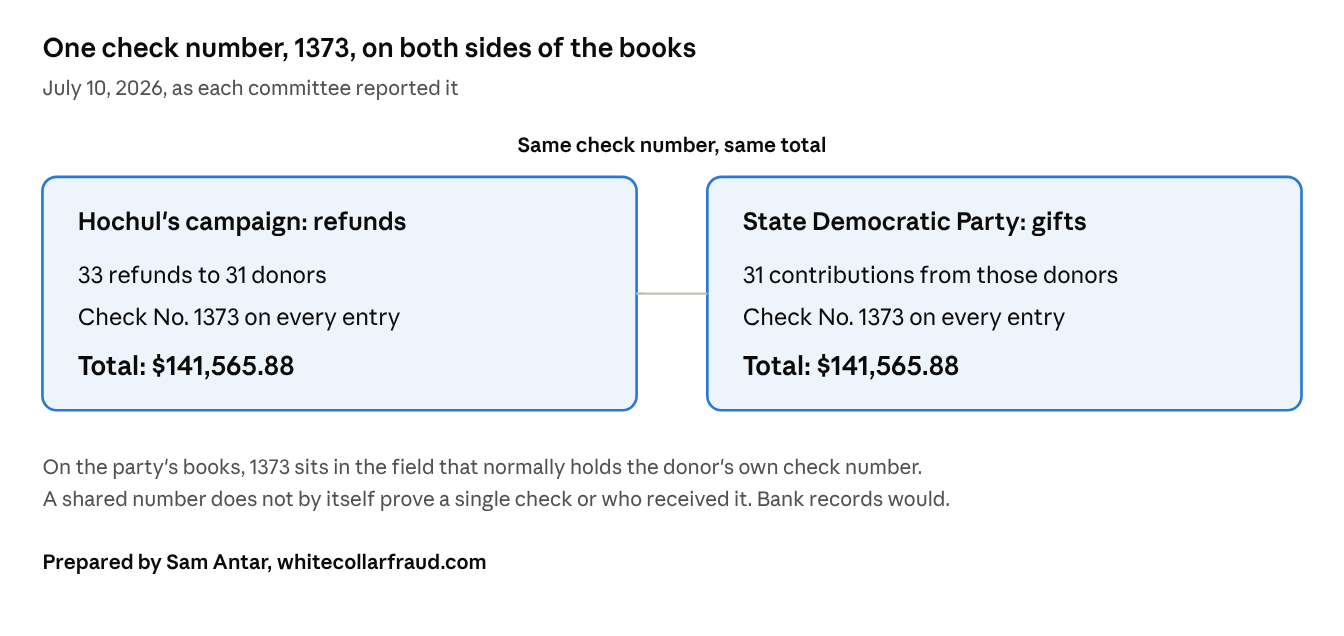
One check number for 33 refunds. On July 10, Hochul’s campaign reported 33 refunds to 31 donors, totaling $141,565.88. Every one was listed under the same check number: 1373. The same day, the party reported 31 contributions from those donors, for the same total. In the space where a donor’s own check number normally goes, every one of the party’s entries says 1373.
That raises an obvious question: did a single payment go from the campaign to the party, recorded as refunds on one side and donor gifts on the other? The shared number alone doesn’t prove it. Bank records would show who the payment went to.
47 refunds, one check number, same order. Three days earlier, on July 7, the campaign reported 47 refunds totaling $418,500, all under check number 10001. On July 10, the party reported 47 wire transfers from donors with the same names, for the same amounts, totaling the same $418,500. The party’s 47 entries are numbered in the same donor order as the campaign’s. That suggests both sets were prepared from a common list. The records don’t show who prepared it. A few donors in these two batches didn’t pass my address check, $25,000 in the first and $27,000 in the second, so they aren’t counted in the $2.38 million.
The same total, recorded two ways. On October 19, the last date this analysis covers, the party’s books show $372,519.98 coming in two different ways: as two payments from Hochul’s campaign, and separately as gifts from 55 donors totaling exactly the same amount. Both count in the party’s reported totals. Hochul’s reports for that day show refunds to donors and no payment to the party. The records leave open what the two sets represent: separate money, double reporting, a reporting error, or refund money the campaign paid straight to the party, which the party then credited to the donors. That last possibility raises a pointed question. If Hochul’s campaign did pay the party that day, why, when the party had just sent her $16.5 million?
What the donors’ own books say
Most donors are individuals who file nothing. But political action committees file their own reports of the refunds they receive and the contributions they make. I checked 17 of them.
Two say plainly that their refund went to the party. The New York Bankers PAC described a $6,000 refund from Hochul’s campaign as a “Constructive refund redirected to NYSDC at PACs direction,” and its $6,000 gift to the party as “funded through redirected Friends for Kathy Hochul refund.” Molina Healthcare’s PAC described its $9,000 gift to the party as a “Redirection of funds from returned Friends of Hochul Contribution.”
These are the clearest filing statements that the two party gifts were funded through Hochul refunds. Neither PAC’s filing addresses what happened to the money after it reached the party.
The dates don’t line up neatly, either. The Bankers PAC recorded its transaction on September 30. Hochul’s campaign and the party recorded theirs on October 19.
For eight more PACs, credited by the party with $45,000, I found no corresponding refund and contribution entries in their reviewed NYS filings.
The $16.5 million
On September 25, the party sent Hochul’s campaign $10 million. On October 16, it sent another $6.5 million. Both sides report both transfers. Together they were 94% of the $17.51 million the party’s campaign account transferred to other committees in 2026. Party transfers to candidates are legal in New York, and there is no limit on them.
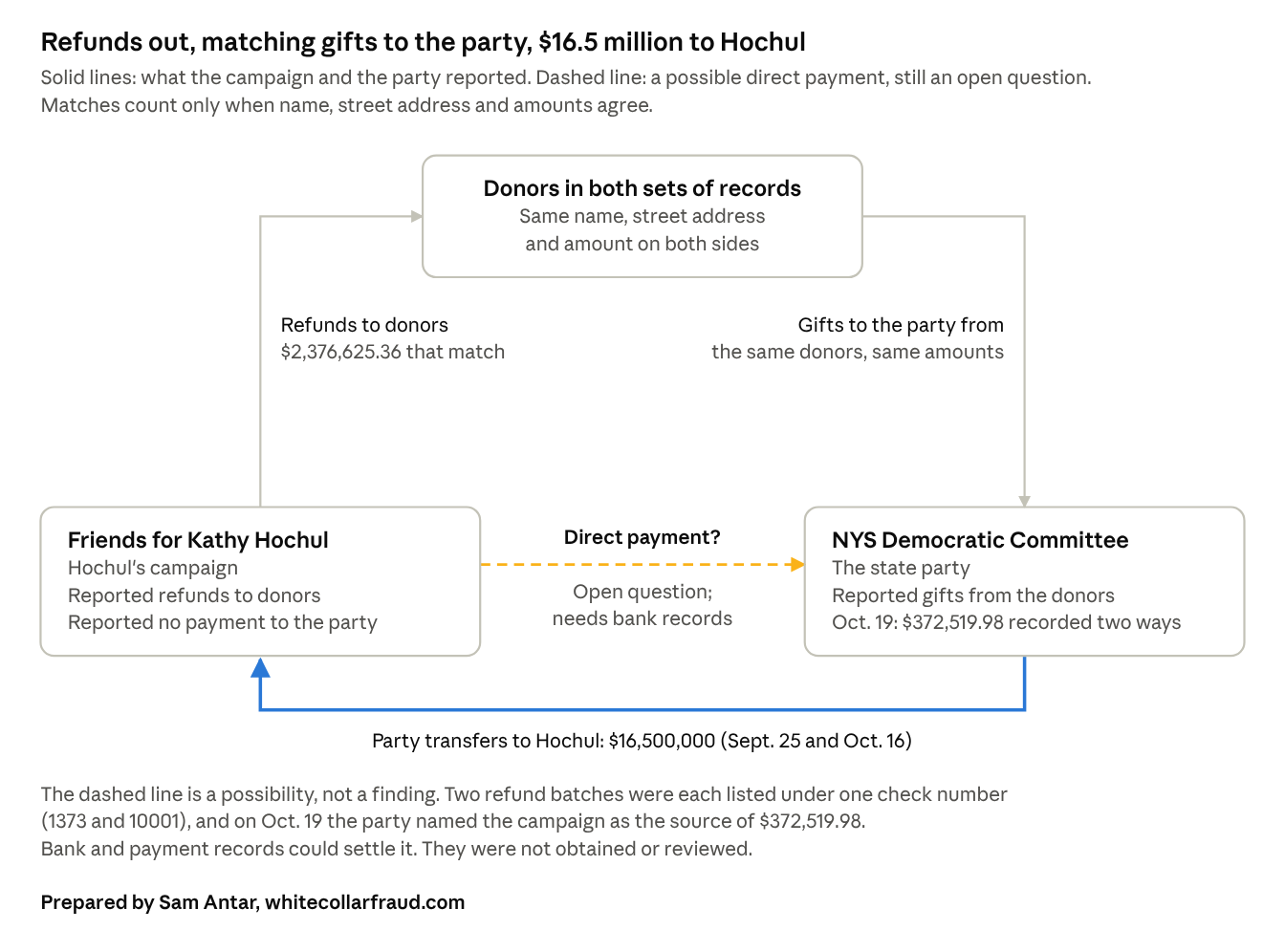
By the first transfer, the party had taken in $2,129,013.38 in matching donor gifts. Could the party have paid Hochul without that money? On its own reported numbers, yes. In a day-by-day rebuild of the party’s cash from its reports, it still had enough for both transfers without any of the matching gifts; its lowest balance would have been about $1.7 million. But the question isn’t whether the party could afford the transfers. It’s whether the refunds and the transfers were connected, and money is interchangeable.
The campaign and the party dated $247,611.98 of the matching gifts October 19, after both transfers. Reported dates may not reflect when money actually moved, though. As noted above, the Bankers PAC dated its side of the transaction weeks earlier than the campaign and the party did.
In 2022, when Hochul last ran for governor, the party’s state campaign account reported no direct transfers to her campaign. In 2026, it reported $16.5 million. That comparison concerns direct transfers, not every way a party can support a candidate. How did the party decide on the payments, and was there any understanding connecting them to the refunded donations? Only the party’s records can answer that.
Why it matters
I have seen, both as a criminal and as a forensic accountant, how irregularities can be papered over. That experience makes me ask whether the documents accurately describe what happened. It shapes how I read these records. It is a reason to ask questions, not proof that anything here was concealed.
Here is where the law comes in. Election Law §14-120 requires contributions to be made and recorded in the real contributor’s name. The separate question is whether these were independent donations and party transfers or parts of an arrangement to route refunded money back to Hochul. Who directed the payments, what donors were told, and what the party agreed to do could help answer it. The records reviewed neither establish nor rule out such an arrangement, and no violation has been established.
That is why the pattern matters. The public can see its shape in the filings. What the public can’t see is whether that shape is coincidence or design. The committees’ records could help answer that question.
If money a campaign must return to its donors can flow into the party that funds the campaign, what does the limit actually limit?
The innocent explanation
The campaign has offered its own explanation. Its spokesman, Ryan Radulovacki, told New York Focus that after the refunds went out, the campaign contacted the donors and suggested they support Democratic candidates “up and down the ballot.” Those who said yes “were given a form that allowed their reimbursed funds to be directed to the party committee.” One donor, Lou Coletti, told New York Focus the campaign asked whether he would support the party, and that Hochul’s name “never came up.”
On that account, donors chose to give their refunds to the party, and the campaign made it easy. The two PAC filings fit that account; the Bankers PAC says it acted at its own direction. If donors were entitled to refunds and chose where they went, that could explain why the party credited the gifts to them.
But that explanation answers only part of the question. By the campaign’s own account, the redirects started with the campaign, not the donors. A form that sent refund money straight to the party could also explain why both committees show the same check numbers, and why the party recorded payments from the campaign on October 19. And it would not explain how the party decided to send Hochul $16.5 million, or whether anyone expected the money to end up with her. A donor’s consent doesn’t prove a connection, and it doesn’t rule one out.
What the records can’t yet answer
Several key facts are missing from the reports reviewed:
- The payment route. Who received the payments reported under check numbers 1373 and 10001, and who sent the party’s matching wires.
- The forms. The campaign says donors who agreed signed a form directing their refunds to the party. The forms, and what they told donors, were not in the reports reviewed.
- An agreement. Campaign finance reports wouldn’t normally record a deal that money would go back to Hochul, and none appears in these.
- The dollar trace. The reports don’t trace particular dollars back to Hochul; as noted above, that may be the wrong test.
- The party’s other account. The party’s separate housekeeping account reports twice a year. I found no matching refund receipts in its available records through July 11. Those records do not cover later activity. Its next regular periodic report is expected in January; donor or bank records could provide answers sooner.
- A violation. This review does not establish a violation.
The other campaigns
I ran the same tests on three other statewide candidates who were unopposed in their primaries: Hochul’s Republican opponent, Bruce Blakeman; Attorney General Letitia James; and James’s Republican opponent, Saritha Komatireddy. Blakeman and Komatireddy, unlike Hochul, take public financing. None of their refunds showed Hochul’s pattern of matching same-day gifts to their parties. What sets Hochul apart isn’t that money moved between her campaign and her party, which happens elsewhere too. It’s the refunds matched by party gifts from the same donors.
The questions that remain
For Hochul’s campaign
- Who received the money recorded under check numbers 1373 and 10001: the donors, or the party?
- The campaign says it gave donors a form directing their refunds to the party. Did that money go to the donors first, or straight to the party? What did the form tell donors about where the money would end up?
- The party says it received $372,519.98 from the campaign on October 19. Why don’t the campaign’s records show that payment?
For the state Democratic Party
- Who actually sent the 47 wires it recorded on July 10?
- How did it decide to send Hochul $16.5 million, and when? Did any donor instructions mention her?
- Why did the party’s state campaign account report no direct transfers to Hochul in 2022 and $16.5 million in 2026?
- Why does it credit eight PACs with $45,000 when no corresponding refund and contribution entries appear in their reviewed NYS filings?
- What do its two sets of receipts on October 19, totaling $372,519.98 each, one from the campaign and one from 55 donors, represent?
Bank statements, payment records, any check images, donor instructions and the party’s transfer-decision records could help answer these questions. I did not obtain or review them. The committees could release them.
The absence of enforcement action does not mean everything was proper. A pattern isn’t proof of wrongdoing. But this one raises questions the committees should answer.
How I did this
Everything here comes from official government records: the campaign finance reports Hochul’s campaign, the state Democratic Party, Blakeman’s campaign, the Republican committees and 17 PACs filed with the New York State Board of Elections. The figures cover transactions through October 19, 2026, as filed on October 27. I did not rely on news reports for any figure or finding. The campaign’s description of its donor forms is as its spokesman gave it to New York Focus.
Matches required compatible full names, the same street address and ZIP code, and equal totals after combining related entries for each donor. Close calls were left out. The matches were checked again in a separate, independent review. The cash figures come from a day-by-day rebuild of the party’s balance from its own reports, using the dates the party reported. Earlier versions of amended reports and filing attachments were not comprehensively reviewed. Committees can amend their reports, and later filings, including the party’s next housekeeping report and post-election reports, could add to or change parts of this picture.
Official sources: New York State Board of Elections campaign finance disclosure reports; 2023 Campaign Finance Handbook, pages 30 and 36; Contribution Limits; 2026 Campaign Finance Filing Calendar; Election Law §14-114 and §14-120; Public Campaign Finance Board, Handbook, revised March 2026, pages 40 to 41.
Written by Sam E. Antar | Forensic Accountant & Fraud Investigator
Follow @SamAntar on X.
© 2026 Sam E. Antar. All rights reserved.