The Laundering Pipeline: DOJ Insiders → Reporters → Headlines → Defense Motions → Amicus Briefs → Congressional Letters → Federal Judge’s Ruling
Prologue: The Real Misconduct
Forty-seven federal crimes. Nine newsrooms. One coordinated operation to obstruct justice.
They screamed “prosecutorial misconduct” until a federal judge cited it as fact. But who really obstructed justice in the Letitia James case?
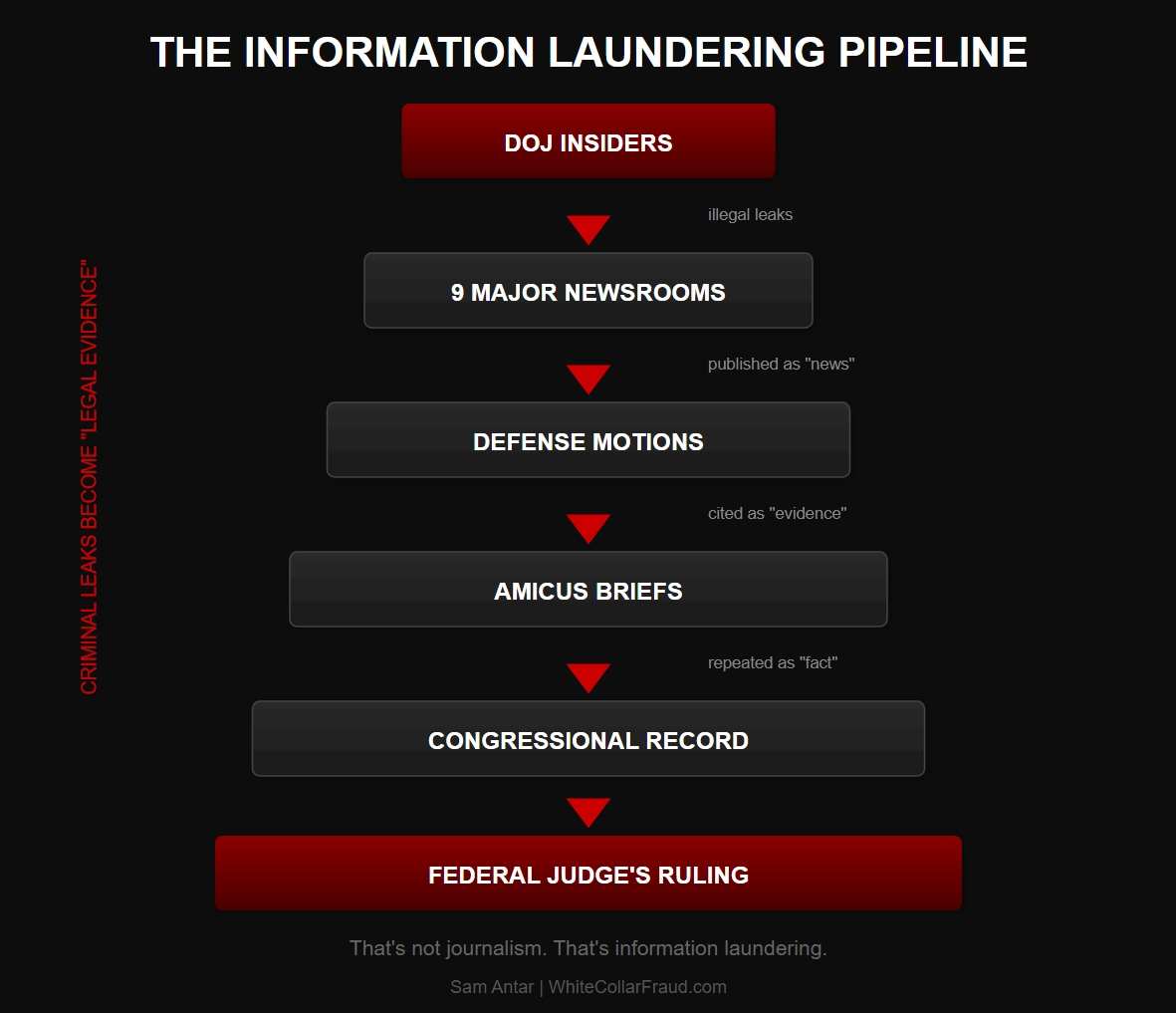
Not Lindsey Halligan, the Interim U.S. Attorney who brought the indictment. The receipts point inside the building: 47 documented leaks from DOJ insiders, exposed by their own attribution lines — “speaking on condition of anonymity to discuss non-public investigations.” Nine newsrooms published anyway, knowing their sources were committing federal crimes — while ignoring the public documents proving her guilt. A collective chorus using criminal sources to protect a criminal defendant. A political machine laundered those illegal disclosures through defense motions, amicus briefs, congressional letters — until they became footnotes in a federal judge’s ruling.
The indictment was dismissed on a procedural technicality. The evidence remains. The documents haven’t changed. And DOJ can re-indict tomorrow.
I expect they will — with a superseding indictment covering the other properties. The dismissal didn’t save James. It only delayed the inevitable into the 2026 election cycle.
I documented every leak. I traced the pipeline. I followed the messaging and the machinery.
This is the story they don’t want you to read.
Click on any image to enlarge
On November 24, 2025, Judge Cameron McGowan Currie inadvertently revealed where the real misconduct originated.
She dismissed the indictment against Letitia James — not on the merits, not on vindictive prosecution, not because the evidence was weak. She dismissed on the Appointments Clause, ruling that Lindsey Halligan wasn’t properly appointed as Interim U.S. Attorney. A procedural technicality. Dismissal without prejudice.
Judge Currie was brought in by the Fourth Circuit solely to rule on this constitutional question. She never saw inside the James case. She never evaluated the evidence. She never ruled on the misconduct allegations Abbe Lowell spent 50 pages briefing.
And neither did Judge Walker. The case’s original judge — the one who would have ruled on Lowell’s vindictive prosecution claims — never got the chance. Currie’s Appointments Clause dismissal mooted the pending motion. All those laundered leaks, all those footnotes citing anonymous sources, all those amicus briefs repeating leaked claims — none of it was ever adjudicated. The “misconduct” narrative that nine newsrooms spent months constructing was never tested in court.
If DOJ re-indicts with a properly appointed prosecutor, Lowell starts from zero.
But buried in her ruling was this sentence: (Source: Order Granting Motion to Dismiss, ECF No. 118, Page 4)
“On September 19, 2025, Mr. Siebert informed colleagues of his resignation. According to news reports, Mr. Siebert had recently expressed concerns to senior Department of Justice officials about the viability of pursuing charges against Ms. James and former FBI Director James Comey.”
A federal judge cited “news reports” as her source for what a U.S. Attorney privately communicated to senior DOJ officials.
Those news reports came from anonymous government sources who broke federal law. Their illegal disclosures traveled so far — through headlines, court filings, congressional letters — that a judge ruling on an unrelated procedural question treated them as background fact.
That’s how successful the operation was.
What They Leaked
Prosecutorial assessments that were never officially released. Grand jury witness testimony protected by Rule 6(e). Witness interview summaries that are confidential law enforcement material. Personnel decisions and their alleged motives. Internal DOJ communications about what leadership knew and when.
Some disclosures violated Rule 6(e) — the federal rule protecting what happens inside the grand jury room. Others violated DOJ confidentiality requirements and potentially the Privacy Act. All were unauthorized.
Every leak helped James. Zero helped the prosecution. That’s not happenstance. That’s coordination.
Some leaks attacked the evidence. Others attacked the investigators themselves — leaking details of an internal ethics probe to paint Martin and Pulte as corrupt before the case even went to trial.
The Pipeline
The media claims the prosecution was weaponized and the evidence didn’t exist. Here’s the weaponization — and the evidence — this article actually documents:
From DOJ to the Courtroom:
1. Government insiders illegally leaked to reporters
2. Reporters published, knowing the disclosures were criminal
3. Defense counsel cited the media reports in court filings
4. Amicus briefs repeated the leaked claims
5. A sitting Congressman cited the same leaks in official correspondence
6. A federal judge cited “news reports” in her ruling
The Echo Chamber:
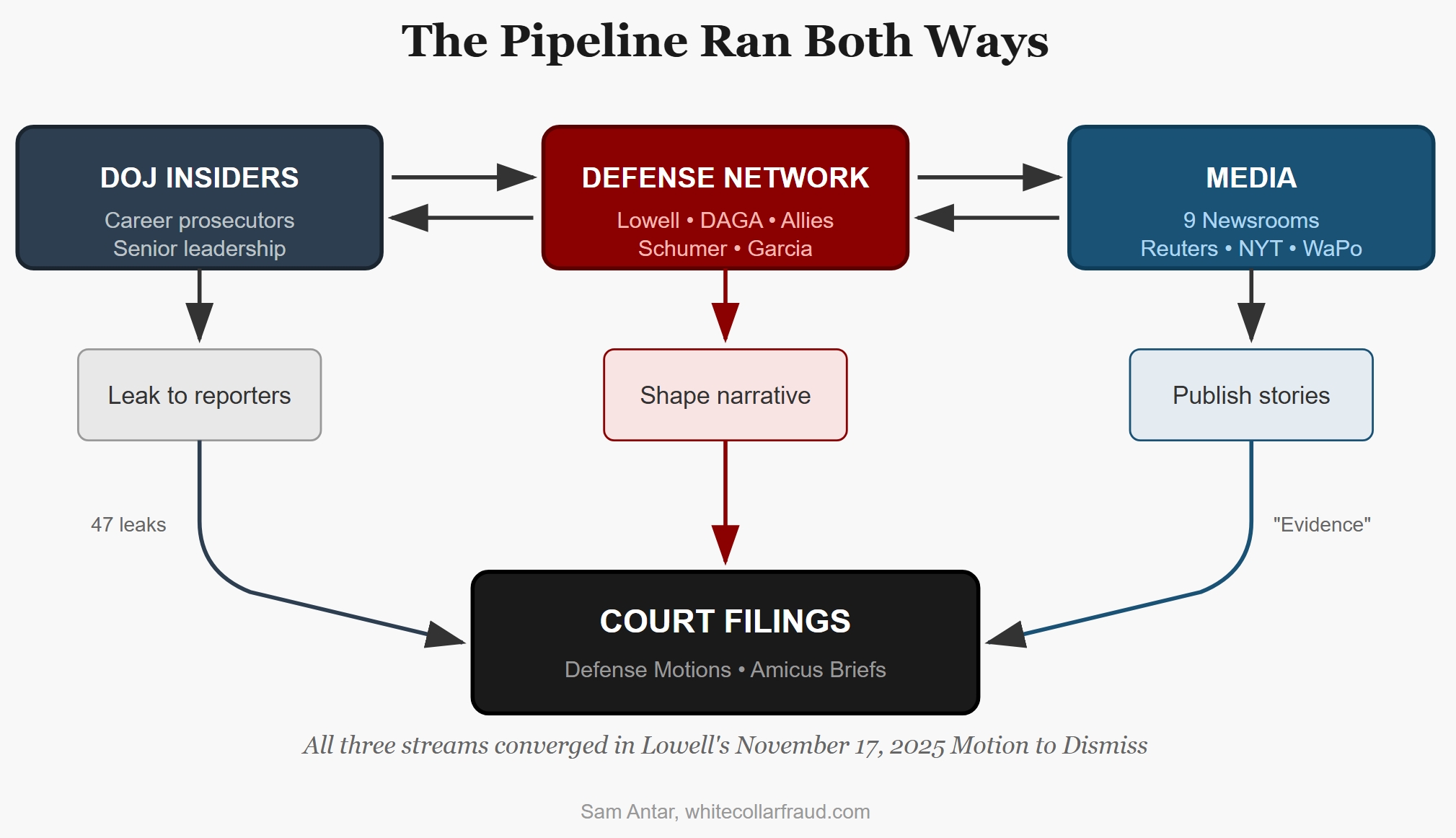
But the pipeline ran both ways.
7. James’s defense team shaped media narratives before citing them as “evidence”
8. Political allies coordinated messaging at the exact moment leaks dropped
9. “Legal experts” published pre-positioned attacks within 24 hours of the indictment
10. When a prosecutor tried to correct false reporting, she was trapped and weaponized
That’s not prosecution misconduct. That’s a sophisticated influence operation — with the defense and political allies on one side, sympathetic DOJ sources on the other, and the media as the transmission belt between them.
The obstruction originated inside the building. The media was the delivery mechanism. And now those same outlets investigate “misconduct” — while ignoring the 47 federal crimes their own sources committed.
And the trail leads higher than career prosecutors.
MSNBC reported on November 20, 2025, in an exclusive by Ken Dilanian and Carol Leonnig, that Deputy Attorney General Todd Blanche and Attorney General Pam Bondi “were never thrilled with these marginal mortgage fraud cases.” According to MSNBC’s sources, the Weaponization Working Group was bypassing Blanche to speak directly to President Trump.
The leaks that sabotaged this case didn’t come from rogue employees. They came from multiple levels of the Justice Department — career prosecutors, senior leadership, possibly others. Whether coordinated or independent, the result was identical: 47 leaks, every one helping James, none helping the prosecution.
And the trail raises an uncomfortable question: If Ed Martin, DOJ’s Special Attorney for Mortgage Fraud and Director of the Weaponization Working Group, and Bill Pulte, Director of the Federal Housing Finance Agency, were bypassing Deputy Attorney General Todd Blanche to speak directly to President Trump, did Blanche — or his allies — have motive to see the case fail?
The Sabotage
The leaks weren’t random. They served a purpose.
The media portrays Erik Siebert and career prosecutors as principled officials who “stood up” to political pressure. But Siebert had access to 40 years of documentary evidence and five months of FBI investigation with subpoena power.
He concluded “insufficient evidence.” Then someone leaked that conclusion to nine newsrooms.
That’s not whistleblowing. That’s sabotage.
And the sabotage had help from outside: political allies coordinating at the exact moment leaks dropped, “legal experts” publishing pre-positioned attacks within 24 hours, and when a prosecutor tried to correct false reporting, she was trapped and weaponized.
The Irony
James’s own attorney, Abbe Lowell, dismissed the evidence against her as “uncorroborated findings of an internet investigator” — referring to my public-records research.
My sources: Property records from county clerks. ACRIS filings accessible to anyone. Financial disclosures on government websites. Recorded mortgage documents. Mathematical impossibilities anyone can verify.
But in his Motion to Dismiss, Lowell cited as authoritative legal evidence: ABC News citing “sources familiar with the matter.” CNN citing “a source familiar with the matter.” Washington Post citing anonymous officials. MSNBC citing government insiders.
Public records anyone can verify = “uncorroborated.”
Anonymous sources committing federal crimes = credible enough for federal court.
That’s the Lowell Standard.
This article documents every leak, every source attribution, every transformation from anonymous disclosure to legal “evidence” — and the machinery that amplified it all.
The receipts are public. The pattern is undeniable. The question no one is asking:
Who inside the Department of Justice coordinated with nine major news outlets to obstruct their own prosecution?
Table of Contents
- Prologue: The Real Misconduct
- Chapter 1: The Documents — The evidence that existed before any leak
- Chapter 2: The Silence — Four months of media inaction
- Chapter 3: The Pipeline Opens — The coordinated leak operation begins
- Chapter 4: The Indictment — The charges and the continuing leaks
- Chapter 5: The Laundering — How leaks became legal arguments
- Chapter 6: The Real Coordination — Who benefited from the leaks
- Chapter 7: The Echo Chamber — How the defense machine shaped the narrative
Chapter 1: The Documents
February 2025: The Evidence Emerges
The documentary evidence proving Letitia James committed mortgage fraud was never hidden. It sat in public databases anyone could access.
I found it.
February 8, 2025: I publish “Beyond Campaign Spending: Letitia James’ Puzzling Property Portfolio Raises New Questions” — the first comprehensive investigation into James’s financial disclosures to New York State, including the Peronne Avenue property in Norfolk, Virginia — the same property that would later be at the center of the federal indictment.
What I documented: The Peronne Avenue property was valued at $100,000-$150,000, yet James disclosed two mortgages — Freedom Mortgage ($150,000-$250,000) and National Mortgage ($100,000-$150,000) — totaling $250,000-$400,000. That’s a loan-to-value ratio of 167% to 400%. No legitimate lender issues loans at 250% of property value. Either the valuation was false or the mortgages were phantom.
February 13, 2025: I publish “Discrepancies in AG Letitia James’ Financial Disclosures” — the results of an independent title search I commissioned on the Peronne Avenue property.
What I found: The Freedom Mortgage and National Mortgage James disclosed did not exist in Norfolk County property records. But the OVM Financial mortgage ($109,600) she used to purchase the property in August 2020 was recorded — and had never appeared on any of her financial disclosures. She was reporting unrecorded mortgages — or phantom mortgages that did not exist — while hiding the real mortgage that does exist.
March 6, 2025: I publish “Accountability on Trial: Letitia James’ Shocking Financial Disclosure Failures” — the first comprehensive analysis of her Brooklyn property disclosures.
What I found: A pattern of delayed reporting, missing mortgages, and shifting classifications. A First Savings Bank loan she’d reported since 2020 had no trace in ACRIS records. A Citibank HELOC recorded in 2019 wasn’t disclosed until 2022 — then vanished from her 2023 disclosure. A Citizens Bank loan recorded in July 2021 was missing from her 2021 disclosure, appeared in 2022 as a “mortgage,” then was reclassified as a “home equity loan” in 2023. The same pattern emerging across multiple properties.
March 2025: Independent Corroboration
I wasn’t the only one following the documents.
March 18, 2025: Gateway Pundit’s Joel Gilbert publishes “Big Development: Is Letitia James Guilty of Mortgage Fraud?” — an independent investigation into the Brooklyn property.
Gilbert documented the 4 vs. 5 units discrepancy on the HAMP loan. A federal program designed to help struggling homeowners — used on a property with more units than James disclosed.
The same day, I publish “Exposed: Letitia James’ Handwritten Mortgage Modifications Raise Fraud Questions.”
What I found buried in NYC property records was damning. The HAMP modification agreement contained multiple contradictory handwritten notations:
- In one corner: “4 fam” — suggesting the property qualified as a four-family dwelling eligible for HAMP
- Elsewhere on the same document: “This security instrument covers real property improved principly [sic] or to be improved by 1 or more structures containing in the aggregate not more than 6 residential units, with each dwelling unit having its own cooking facility”
- Another handwritten note: “By assignment dated 8/23/11 – to be recorded simultaneously herewith” — suggesting mortgage changes were being made retroactively
The misspelling “principly” suggested this was hastily added, possibly by someone other than a legal professional. The phrase “to be improved by” created deliberate ambiguity — a potential loophole to circumvent program requirements.
But the Certificate of Occupancy from January 26, 2001 was unambiguous: Legal five-family dwelling under Building Code classification C2. No approved reduction in unit count had ever been filed with the Department of Buildings. And physical verification confirmed it — six electric meters (five apartments plus common area), five doorbells. The property had never been a four-unit building.
This wasn’t a clerical error. The contradictory handwritten modifications suggested a deliberate attempt to create ambiguity — to justify a loan that would otherwise fail to meet program requirements. James obtained federal mortgage relief through false unit count representation, defrauding a program intended for struggling homeowners with residential properties, not landlords of multi-unit rental buildings.
Two investigators. Different sources. No coordination. Same conclusions.
March 21, 2025: I publish “Building Permits Raise Serious Questions.” Trump shares it the same day on Truth Social.
April 2025: The Paper Trail Expands
April 1, 2025: I publish “EXCLUSIVE: NY Attorney General Letitia James Declares Virginia Home Her ‘Principal Residence’” — documenting the Sterling Street property and the August 17, 2023 sworn declaration I found in Norfolk property records.
What I found in public records: James signed a Power of Attorney on August 17, 2023, swearing under oath “I HEREBY DECLARE that I intend to occupy this property as my principal residence.” That document was filed with the deed and mortgage on August 31, 2023.
The contradiction was already visible: New York’s Attorney General — constitutionally required to reside in New York — had sworn a Virginia property would be her principal residence. On October 2, 2023, she launched the Trump fraud trial in Manhattan. She never moved to Virginia.
April 10, 2025: Trump shares the Sterling Street investigation on Truth Social.
April 14, 2025: The Federal Government Takes Notice
April 14, 2025: FHFA Director Bill Pulte issues a criminal referral to the Department of Justice.
The referral cited publicly available investigations — my work, Joel Gilbert’s work — as part of the factual basis. It focused on Sterling Street in Norfolk and properties in Brooklyn and Queens. Notably, it did not include the Peronne Avenue property I had documented in February — the property prosecutors would later independently choose for the indictment.
This is where Lowell’s narrative claims the “weaponization” began. Trump’s ally Pulte referring Trump’s enemy James for prosecution.
But here’s what Lowell doesn’t mention: The referral cited mine and Gilbert’s public-records research. Research that anyone — including any journalist at Reuters, The New York Times, The Washington Post, The Wall Street Journal, ABC, CBS, NBC, CNN, or MSNBC — could have verified themselves.
They never did.
April 24, 2025: The Defense Backfires
Ten days after the FHFA referral, Abbe Lowell sent a letter to Attorney General Bondi responding to the criminal referral.
Lowell was trying to defend his client. Instead, he handed prosecutors the evidence that proved intent.
In that letter, Lowell produced documents he thought would help James — including an August 2, 2023 email where James told her broker “This property WILL NOT be my primary residence.” On August 3, the broker confirmed the loan was locked as a “primary residence product.”
Fifteen days later, James signed the sworn declaration I had already found in public records.
The timeline Lowell’s own letter established:
- August 2, 2023: James emails broker: “This property WILL NOT be my primary residence”
- August 3, 2023: Broker confirms loan locked as “primary residence product”
- August 17, 2023: James signs Power of Attorney swearing she intends to occupy property as “principal residence”
- August 31, 2023: Purchase completed, documents filed with deed and mortgage
- October 2, 2023: James launches Trump fraud trial in Manhattan — never moved to Virginia
Lowell also made a critical admission: James was a “non-occupying co-borrower” with “no intent to occupy” the Norfolk property.
Read that again.
James’s own lawyer admitted in writing that she never intended to occupy the property she certified under penalty of perjury would be her principal residence. And his letter produced the email proving she knew it was false when she signed.
The documents were speaking. The defense was confirming. And the media was silent.
April–May 2025: Physical Verification
April 21, 2025: I publish “The Fifth Unit: How Electric Meters Expose the Truth About AG Letitia James’ Property.”
What I found: Con Edison records showed six meters for individual apartments plus one common area meter at James’s Brooklyn property. James’s mortgage documents claimed four units. The building’s Certificate of Occupancy showed five. Con Ed showed six.
April 29, 2025: Joel Gilbert and I visit the Brooklyn property in person. He publishes “BIG NEWS: My Visit to Letitia James’s Apartment Building CONFIRMS Mortgage Fraud Allegations (VIDEO).”
What we found: Five doorbells to five apartments — confirming the Certificate of Occupancy and contradicting James’s mortgage documents.
The fraud wasn’t hiding. It was visible from the sidewalk.
May 17, 2025: I publish “Exclusive: Letitia James’ 2024 Financial Disclosure: Missing Properties & Phantom Mortgages.”
Even while under investigation, James filed a 2024 financial disclosure containing the same omissions as prior years. The phantom mortgages remained phantom. The missing properties stayed missing.
The Scorecard: What Existed Before the First Leak
By May 2025 — four months before the first media leak — the public record contained:
| Evidence | Source | Status |
|---|---|---|
| Mathematical impossibilities in financial disclosures | NY JCOPE Database | Public |
| Phantom mortgages revealed by title search | Norfolk County Recorder | Public |
| August 2, 2023 “WILL NOT be primary residence” email | Lowell Letter (ECF 109-2) | Backfired |
| August 17, 2023 sworn declaration | Norfolk County Recorder | Public |
| Second Home Rider prohibiting rental | Norfolk County Recorder | Public |
| Brooklyn 5-unit Certificate of Occupancy | NYC DOB | Public |
| Con Ed records showing 6 apartment meters + common | Con Edison | Public |
| Five doorbells at Brooklyn property | Physical inspection | Verified |
| Lowell letter admitting “non-occupying co-borrower” | April 24, 2025 (public) | Backfired |
| FHFA criminal referral | April 14, 2025 (public) | Public |
Two independent investigators using only public records had documented systematic mortgage fraud spanning 40 years and four properties.
The FHFA found it sufficient to issue a criminal referral.
Lowell’s own letter confirmed the key facts.
And nine major newsrooms — Reuters, The New York Times, The Washington Post, The Wall Street Journal, ABC News, CBS News, NBC News, CNN, and MSNBC — had access to all of it.
They would ignore every document.
They would wait for the leaks.
Chapter 2: The Silence
May–September 2025: The Investigation No One Covered
For four months, federal investigators did what journalists wouldn’t.
The FBI opened a formal investigation. They had subpoena power. They could compel witnesses to testify under oath. They could obtain bank records, mortgage documents, communications — everything that sat in public databases, plus everything that didn’t.
Erik Siebert, the U.S. Attorney for the Eastern District of Virginia, oversaw the investigation. Career prosecutors Elizabeth Yusi and Kristin Bird led the day-to-day work. They interviewed witnesses. They reviewed documents. They built a case — or decided not to.
We know this investigation happened. We know it lasted months. We know prosecutors had access to everything I had found in public records, plus whatever their subpoenas produced.
What we don’t know is what they concluded — because that information was protected. Internal prosecutorial deliberations are among the most closely guarded secrets in federal law enforcement. What career prosecutors recommend, what supervisors decide, what memos say — none of that is public.
Unless someone leaks it.
The Media’s Four-Month Silence
Between May and mid-September 2025, the nine major outlets that would later publish leaks about this case published nothing of substance. No investigative reports. No document analysis. No examination of the mathematical impossibilities sitting in public databases.
Reuters, The New York Times, The Washington Post, The Wall Street Journal, ABC, CBS, NBC, CNN, MSNBC — none of them looked at the records I’d been documenting since February.
They weren’t investigating. They were waiting.
The phone calls were coming.
Chapter 3: The Pipeline Opens
September 17, 2025: The Coordinated Strike
On September 17, 2025, something extraordinary happened.
Three major news outlets — ABC News, CNN, and Reuters — published nearly identical stories within 48 hours. All three contained the same core claim: career federal prosecutors had found insufficient evidence to charge Letitia James.
This was not public information. No court filing disclosed it. No press conference announced it. No official statement confirmed it.
Someone inside the Department of Justice was talking.
ABC News (September 17, 2025): (Peter Charalambous, Katherine Faulders, Alexander Mallin) (Source: ABC News)
“After a five-month investigation and interviews with more than a dozen witnesses, federal prosecutors have so far uncovered no clear evidence that James knowingly made false statements to a financial institution to secure favorable terms on a mortgage for her Virginia home, according to multiple sources briefed on the investigation.”
But ABC’s sources went far beyond general conclusions. Count what they leaked:
Grand jury proceedings: “Since federal prosecutors began looking into James’ Virginia property, they have interviewed or presented to the grand jury 15 witnesses, including insurers, loan officers, underwriters, realtors, and James’ niece.”
Specific witness testimony: “A loan underwriter interviewed by investigators said that, in the process of approving the loan, she never looked at or considered the power of attorney document that incorrectly listed the home as James’ primary residence, according to sources.”
Investigative conclusions: “DOJ investigators would later confirm Lowell’s claim that the POA document was the only document in James’ mortgage file that stated she would live in the home, sources said.”
Internal DOJ recruiting materials: ABC obtained Ed Martin’s “Help Wanted” recruiting email — “according to materials reviewed by ABC News.”
Senior DOJ assessments: “Sources said senior DOJ leadership believes Martin would be unable to prove any allegations beyond a reasonable doubt.”
ABC News didn’t have a leak. They had a pipeline into the grand jury room.
CNN (September 17, 2025): (Kristen Holmes, Hannah Rabinowitz, Kara Scannell) (Source: CNN)
“Justice Department prosecutors in Virginia believe they have not gathered enough evidence to indict Letitia James… for mortgage fraud, according to a source familiar with the matter and another person briefed on the matter.”
But CNN went further than ABC. They published defense documents:
“But other documents collected in the case provided by James’ attorneys to the Justice Department and reviewed by CNN show James repeatedly stating the opposite. In one email to a mortgage broker, James wrote that ‘this property WILL NOT be my primary residence.’ And on other forms that asked whether the home would be her primary residence, James checked off ‘NO.'”
CNN was publishing Lowell’s letter to Bondi — the same letter that backfired by proving intent. But CNN presented it as exculpatory.
What CNN failed to report: The August 17, 2023 sworn declaration — in which James certified under penalty of perjury that she would occupy the property as her principal residence — was signed fifteen days AFTER the emails CNN cited. The emails don’t prove innocence. They prove she knew she was lying when she signed the declaration.
CNN didn’t use inside information. They acted as stenographers for the defense narrative without doing basic timeline journalism.
The same article leaked political pressure claims:
“Nonetheless, the US Attorney for the Eastern District of Virginia has faced pressure to indict James from Ed Martin, the head of the Justice Department’s Weaponization Working Group, and Bill Pulte, the director of the Federal Housing Finance Agency, two sources tell CNN.”
Two outlets. Same day. Same message. Same anonymous sourcing. But CNN added something ABC didn’t: defense spin presented as fact.
That is not coincidence. That is coordination.
September 19, 2025: The Flood Continues
Two days later, Reuters and The Washington Post joined the chorus.
Reuters (September 19, 2025): (Sarah N. Lynch, Jeff Mason) (Source: Reuters)
“Siebert has expressed a view that the evidence in both cases was weak and that it would be difficult to bring an indictment against them, the sources said, speaking on condition of anonymity in order to discuss non-public investigations and personnel issues.”
Note the attribution: “speaking on condition of anonymity in order to discuss non-public investigations.”
The sources knew they were disclosing protected information. Reuters knew it was publishing protected information. They did it anyway.
Washington Post (September 19, 2025): (Salvador Rizzo, Perry Stein, Jeremy Roebuck) (Source: Washington Post)
“U.S. Attorney Erik S. Siebert had declined to seek an indictment of James on mortgage fraud charges because of a lack of evidence, according to four people familiar with that investigation.”
But the Post had more than one pipeline. Count the sources:
- “Four people familiar with that investigation” leaked Siebert’s determination on James
- “Two people familiar with that inquiry” leaked Siebert’s decision on Comey
- “Two people familiar with the discussions” leaked that Deputy AG Todd Blanche lobbied for Siebert
- “People familiar with the matter” leaked that Pulte and Martin pushed for Siebert’s removal
The Washington Post didn’t have a source. They had a network — multiple officials across different levels of DOJ, all leaking the same day, all “speaking on the condition of anonymity to discuss internal deliberations.”
Four outlets. Three days. One message.
The pipeline was open.
The Anatomy of a Leak Operation
What does a coordinated leak operation look like? Exactly like this.
Simultaneity: Multiple outlets publish the same information within a narrow window. This isn’t reporters independently discovering facts — it’s sources feeding the same material to multiple journalists.
Consistent framing: Every story carried the same message. Not “prosecutors are divided” or “evidence is being evaluated.” The message was definitive: the case is weak, the evidence is insufficient, career prosecutors declined.
Uniform attribution: Every outlet used nearly identical language — “sources familiar with the matter,” “people familiar with internal deliberations,” “speaking on condition of anonymity to discuss non-public investigations.”
One-directional benefit: Every leak helped James. Not a single leak suggested the evidence was strong. Not a single leak indicated documents supported the charges. Not a single leak portrayed the case favorably.
If the leaks were neutral — just government employees sharing information — you’d expect some to cut both ways. Some leaks might say “prosecutors found strong evidence on Property A but weak evidence on Property B.”
That’s not what happened.
Every leak said the same thing: James did nothing wrong. The case is political. The prosecutors found nothing.
Who Had This Information?
Ask the obvious question: Who knew what career prosecutors concluded?
Not the courts. No filing had been made. No judge had been briefed.
Not Congress. No oversight hearing had occurred.
Defense counsel? The original source had to be inside DOJ — only they knew what prosecutors concluded. But the information could have been funneled through defense counsel to the press. Consider: Lowell’s November 17 Motion to Dismiss would later cite these very articles as evidence — the same articles based on anonymous sources with access to internal DOJ deliberations. If leaked information flowed from DOJ to defense counsel to the press, then citing those articles in court filings would be laundering that information into the official record. In any case, the press was laundering information that found its way into court. That’s exactly what Chapter 5 documents.
Either way, someone inside DOJ was illegally leaking selective information designed to benefit James. The leaks came from inside the building.
The Same Day: Siebert Exits
On September 19, 2025 — the same day Reuters and Washington Post published their leaks — Erik Siebert resigned as U.S. Attorney.
ABC News (September 19, 2025): (Katherine Faulders, Peter Charalambous, Alexander Mallin) (Source: ABC News)
“While sources caution that plans could still change, Siebert was notified on Thursday of Trump’s intention to fire him, sources told ABC News, and was told that Friday would be his final day on the job.”
Reuters (September 19, 2025): (Sarah N. Lynch, Jeff Mason) (Source: Reuters)
“Erik Siebert, the U.S. Attorney for the Eastern District of Virginia, informed his staff about his resignation not long after Trump told reporters at the White House he had lost confidence in him, according to an internal email seen by Reuters and a person familiar with the matter.”
Reuters obtained an internal DOJ email. On the same day it was sent.
Someone inside the Justice Department was feeding information to reporters in real time.
The New York Times (September 19, 2025): (Glenn Thrush, Maggie Haberman, Jonah E. Bromwich, Alan Feuer, William K. Rashbaum) (Source: New York Times)
Five reporters. One article. Multiple anonymous sources:
“Mr. Siebert has recently told senior Justice Department officials that investigators found insufficient evidence to bring charges against Ms. James… according to officials”
“Attorney General Pam Bondi and Todd Blanche…had privately defended Mr. Siebert against officials, including William J. Pulte…who had urged that he be fired, according to a senior law enforcement official”
“Mr. Blanche has also questioned the legal viability of bringing charges against Ms. James, according to current and former department officials who spoke on the condition of anonymity”
Private conversations between the Attorney General and Deputy Attorney General. Internal prosecutorial assessments. All leaked to five reporters on a single day.
The Narrative Takes Shape
Within 72 hours, the media had constructed a complete narrative:
1. Career prosecutors investigated for months
2. They found insufficient evidence
3. They declined to bring charges
4. Siebert was pushed out for refusing to prosecute
5. Any future charges would be political retaliation
This narrative would become the foundation of James’s legal defense.
But notice what the narrative required the public to believe:
- That anonymous sources were telling the truth
- That internal prosecutorial assessments were accurately characterized
- That “insufficient evidence” was a proper conclusion
- That the 115,000 pages of documents later produced were somehow inadequate
And notice what the narrative required the public to ignore:
- The documented contradictions in James’s sworn statements
- The mathematical impossibilities in her financial disclosures
- The physical evidence of more units than she claimed
- The admission in Lowell’s own letter
- Everything I had published since February
The leaks told a story. The documents told a different story.
The media chose the leaks.
September 20, 2025: Trump Responds
The day after the leak barrage, Trump posted on Truth Social:
“Then we almost put in a Democrat supported U.S. Attorney, in Virginia, with a really bad Republican past. A Woke RINO, who was never going to do his job… He even lied to the media and said he quit, and that we had no case. No, I fired him, and there is a GREAT CASE…”
Note the sequence: The leaks came first. Trump was responding to them.
Lowell’s November 17 Motion to Dismiss would later call this post the “apex” of “outrageous government conduct” — proof of vindictive prosecution.
But look at the timeline:
- September 17-19: Anonymous sources leak that career prosecutors found “insufficient evidence”
- September 19: Siebert exits
- September 20: Trump responds to what he calls lies “to the media”
September 22, 2025 — Washington Post (Jeremy Roebuck, Salvador Rizzo)
Three days after Siebert’s exit, the Post published a deep dive into DOJ turmoil. The leaks embedded in this single article:
- “Deputy Attorney General Todd Blanche… had pushed to keep Siebert on the job, according to two people familiar with those discussions“
- “Prosecutors described a widespread sense of confusion”
- “Several of the office’s current and former prosecutors, who spoke on the condition of anonymity for fear of reprisals“
- A prosecutor predicting James wouldn’t be indicted: “If you don’t have the evidence, you don’t have the prosecutors and you don’t have the grand jury all on the same page, it doesn’t matter who is in the office”
Internal DOJ deliberations, personnel decisions, prosecutorial predictions — all leaked. And all later cited by Lowell in Footnote 33 of his motion as legal authority.
The Double Standard
Here’s the devastating irony: In his November 17, 2025 Motion to Dismiss, Lowell dismissed my work as “uncorroborated findings of an internet investigator” and attacked the FHFA referral as “lacking any credible foundation.” But Pulte’s referral didn’t even include Peronne Avenue — the property prosecutors independently chose for the indictment. That came from my February research, which prosecutors corroborated with their own subpoenas.
My sources: Public property records from county clerks. ACRIS filings accessible to anyone. NY State Financial Disclosures on government websites. Recorded mortgage documents. Mathematical impossibilities anyone can verify.
But in that same motion, Lowell cited as authoritative legal evidence:
- ABC News citing “sources familiar with the matter”
- CNN citing “a source familiar with the matter”
- Washington Post citing “two people familiar with those discussions”
- MSNBC citing anonymous government insiders
The Lowell Standard: Public records anyone can verify = “uncorroborated.” Anonymous sources committing federal crimes by leaking = credible enough for federal court.
The leaks created the predicate. They were designed to either kill the case before Trump could act — or, if indictment came anyway, to provide ammunition for a vindictive prosecution claim.
Lowell’s motion completed the circle: cite the leaks as evidence, cite Trump’s response as vindictive prosecution, never mention that the leaks started it.
Chapter 4: The Indictment
October 9, 2025: The Charges
Three weeks after the leak operation began, Letitia James was indicted.
Two counts. One property. Mortgage fraud.
But here’s what the media missed — and what destroys the “political coordination” narrative:
James was indicted for Peronne Avenue. (Source: Indictment, Case 2:25-cr-00122)
Peronne Avenue was the property I documented in my February and March 2025 investigations.
Peronne Avenue was not in Pulte’s April 14 criminal referral. That referral focused on Sterling Street and Brooklyn.
The prosecutors independently chose to charge the property I had documented months earlier — not the properties the FHFA Director referred.
The DOJ’s own response made this explicit: (Source: DOJ Response, ECF No. 117, Page 21)
“The facts on which the United States Attorney based the charges have nothing to do with the Sterling property in Norfolk, Virginia, or property in Brooklyn, New York.”
Read that again.
Pulte referred Sterling Street and Brooklyn. Prosecutors charged Peronne Avenue. Same source material — my public-records investigations — but different charging decisions.
That’s not coordination. That’s prosecutorial independence.
Federal prosecutors with subpoena power reviewed the evidence, corroborated my public-records analysis, and made their own decision about what to charge.
But by October 9, the narrative was already set. The leaks had done their work.
What Every Outlet Ignored
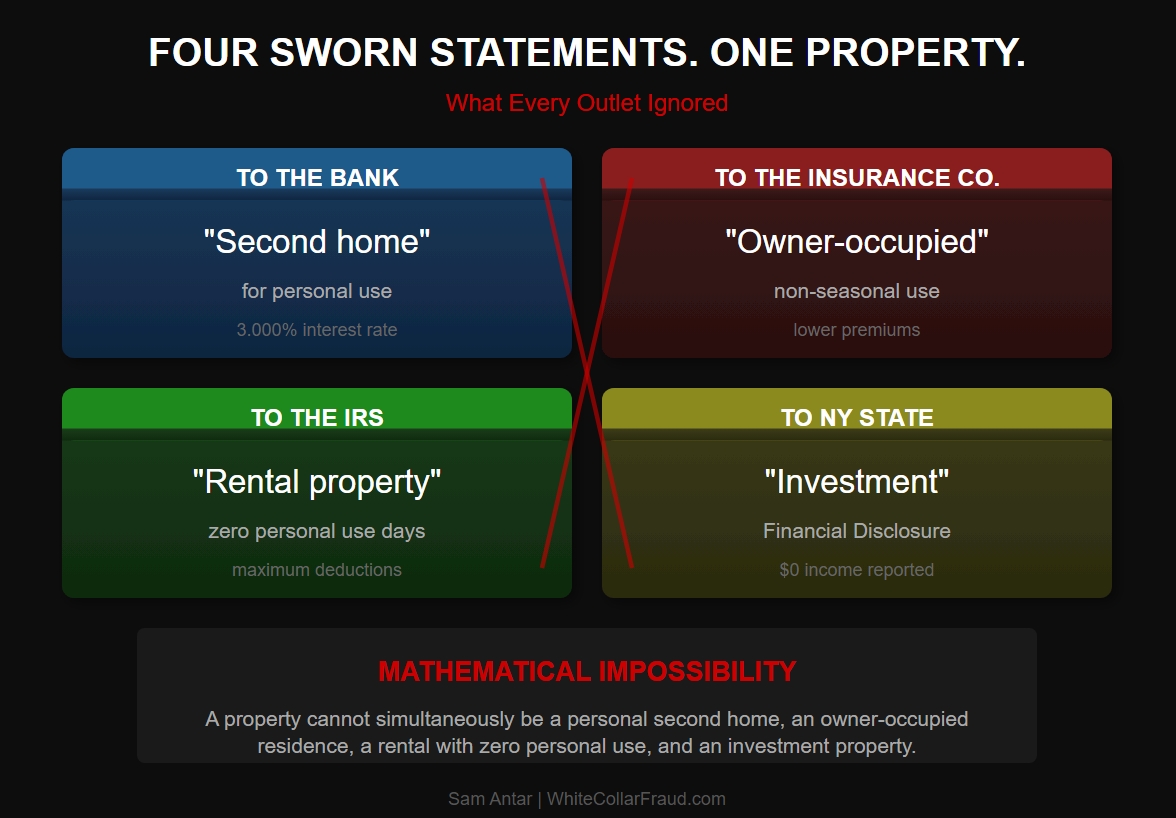
The indictment documented James making contradictory sworn statements about the same property:
- To the bank: “Second home” for personal use
- To the insurance company: “Owner-occupied”
- To the IRS: “Rental property” with “zero personal use days”
Her NY State Financial Disclosures — which I documented months before the indictment — added a fourth: “Investment” property.
Four sworn statements. Four different classifications. Mathematical impossibility.
This wasn’t a “weak case.” This was systematic fraud documented in her own sworn statements.
Reuters didn’t report it. The New York Times didn’t report it. The Washington Post didn’t report it. ABC, CBS, NBC, CNN, MSNBC — not one of them reported it. Lawfare’s Molly Roberts called the case “dangerously weak” without mentioning it. The amicus briefs ignored it. Congressman Garcia’s letter ignored it.
Every outlet that called this case “weak” did so by burying the strongest evidence.
That’s not journalism. That’s protection.
The Leaks Continue: A Chronological Record
The indictment didn’t stop the pipeline. It accelerated it. Here is every major leak, in order:
October 6, 2025 — MSNBC (Carol Leonnig & Ken Dilanian) (Three days before indictment)
“Elizabeth Yusi, who oversees major criminal prosecutions in the Norfolk office of the Eastern District of Virginia, has confided to co-workers that she sees no probable cause to believe James engaged in mortgage fraud, the two sources told MSNBC.”
Someone leaked what a career prosecutor said to her co-workers. Private workplace conversations became national news.
“Career prosecutors in the Eastern District of Virginia also fear their colleagues will be pressured to seek an indictment against James, or risk being fired, the two people familiar with internal discussions said.”
Internal fears. Internal discussions. All leaked.
October 9, 2025 — Reuters (Sarah N. Lynch, Luc Cohen, Andrew Goudsward) (Day of indictment)
“As with the Comey case, Halligan presented the evidence against James to the grand jury by herself, without support from career prosecutors in the office, a person familiar with the matter said.”
Grand jury proceedings are secret. Federal Rule of Criminal Procedure 6(e) protects them. Unauthorized disclosure is potentially criminal.
Someone disclosed anyway.
October 9, 2025 — ABC News (Pierre Thomas, Katherine Faulders, Luke Barr, Alexander Mallin) (Day of indictment)
“Attorney General Pam Bondi and other senior leadership of the Justice Department were caught off guard Thursday by news that the Trump-installed U.S. attorney for the Eastern District of Virginia had presented to a grand jury seeking an indictment of New York Attorney General Letitia James, multiple sources familiar with the matter told ABC News.”
“While Bondi, Deputy Attorney General Todd Blanche and other DOJ officials had expected Lindsey Halligan would move forward in seeking to indict James, against the recommendation of prosecutors in the office who had investigated for months the claims she committed mortgage fraud, they were not informed until after Halligan had already presented the case, sources said.”
Think about what this leak required. Someone inside DOJ knew what the Attorney General knew. Someone knew when she knew it. Someone knew about internal communications between Main Justice and the Eastern District of Virginia.
And someone decided the public needed to know that leadership was “caught off guard” — framing the indictment as a rogue action rather than an institutional decision.
October 9, 2025 — NBC News (Kelly O’Donnell, Garrett Haake) (Day of indictment)
“A federal grand jury in Virginia indicted New York Attorney General Letitia James on bank fraud charges, three sources familiar with the matter confirmed to NBC News.”
NBC confirmed the sealed indictment before it was officially announced. Three separate sources leaked to a single network on the same day — disclosing the existence of a sealed indictment in potential violation of Rule 6(e)(4).
But Kelly O’Donnell went further, leaking internal DOJ deliberations:
“We believe that there was pushback within the Department of Justice about the strength of the evidence here.”
Internal DOJ “pushback” is not public information. Someone inside the Department told NBC News about internal disagreements — in real time, on the day of indictment.
October 11, 2025 — The New York Times (Jonah E. Bromwich, Kate Kelly, Stefanos Chen) (Two days after indictment)
The Times published a lengthy feature on the Norfolk property. Buried in its 1,500 words were multiple leaks:
Leak #1 — Grand jury testimony:
“But in June, Ms. Thompson testified to a grand jury in Norfolk that she had lived in the house for years and that she did not pay rent, a person familiar with her testimony said.”
Grand jury proceedings are secret under Federal Rule of Criminal Procedure 6(e). What a witness tells a grand jury is among the most protected information in the federal system. Someone disclosed it anyway.
Leak #2 — Grand jury procedure:
“She was not asked to testify again, and the grand jury that voted to indict Ms. James was not seated in Norfolk, but in Alexandria.”
Someone knew which grand jury heard which testimony — and which grand jury returned the indictment. Internal DOJ procedure, leaked.
Leak #3 — Career prosecutor opposition (echoed):
“Mr. Siebert had cast doubt on the case, as had career prosecutors in the office.”
The same narrative from September, now treated as established fact.
Leak #4 — Financial benefit framing:
The article emphasized “the paltry amount Ms. James is accused of having stood to gain — $18,933.”
The Times found experts to minimize the charges. A University of Maryland professor who “once oversaw risk management for Citi’s consumer lending practice” explained that banks often “stand down” on such cases because “there’s a lot of gray.”
What the experts didn’t mention: The financial benefit isn’t the crime. The false statement is the crime. Under United States v. Wells, 519 U.S. 482 (1997), prosecutors don’t need to prove the bank relied on the statement or that it was material.
October 17, 2025 — ABC News (Katherine Faulders, Olivia Rubin, Alexander Mallin)
“Elizabeth Yusi, the top criminal prosecutor for the Norfolk office, and her deputy Kristin Bird were informed of their removals Friday — marking the latest firings in one of the most important federal prosecutorial offices in the country.”
“Sources familiar with the matter said their firings were tied to their resistance to bringing charges against James.”
The motive for personnel decisions — information that is never officially disclosed — was leaked to reporters.
October 20, 2025 — CBS News (Scott MacFarlane)
“Two federal prosecutors in the office, Kristin Bird and Elizabeth Yusi, were terminated last week from their posts as assistant U.S. attorneys in the Norfolk office after they voiced opposition to the criminal case against James.”
Same information. Same framing. Multiple outlets reinforcing the narrative.
October 23, 2025 — ABC News (Katherine Faulders, Alexander Mallin, Peter Charalambous, Steven Portnoy) (The memo and witness interviews)
“Prosecutors who investigated New York Attorney General Letitia James for possible mortgage fraud found evidence that would appear to undercut some of the allegations in the indictment of James secured earlier this month — including the degree to which James personally profited from her purchase of the property — according to a memo summarizing the state of the case in September, sources told ABC News.”
ABC obtained the contents of an internal DOJ memo. A memo that has never been officially released. A memo that remains protected attorney work product to this day.
“Prosecutors who led the monthslong investigation into James’ conduct concluded that any financial benefit derived from her allegedly falsified mortgage would have amounted to approximately $800 in the year she purchased the home, sources said.”
The $800 figure. A specific number from an internal assessment. Leaked to minimize the fraud.
The same article leaked witness interview summaries:
“Prosecutors met with James’ niece, who stated that she had never signed a lease, had never paid rent for the home, and that James had often sent her money to cover some of the expenses, the memo concluded, according to sources familiar with its contents.”
“A loan officer who worked with James told investigators that the interest rate for a second home compared to an investment property at the time of James’s purchase would have been between 0.25% and 0.50% lower, a difference that would have amounted to $15 to $30 less in a monthly mortgage payment, or as much as $10,800 less over the life of the 30-year loan, according to sources familiar with what the loan officer told investigators.”
Witness interview summaries — known as 302s — are protected law enforcement information. Only prosecutors, FBI agents, or the witnesses themselves could have disclosed this.
Someone chose to leak it anyway. And every leak minimized the fraud.
October 24, 2025 — CBS News (Jacob Rosen, Melissa Quinn)
“Sources told CBS News that Halligan presented evidence to the Comey and Letitia James grand juries alone, rather than with line prosecutors who had worked on the cases.”
The same grand jury information, leaked again, reinforcing the narrative.
October 24, 2025 — NBC News (Ken Dilanian, Carol Leonnig, Vaughn Hillyard, Fallon Gallagher)
NBC News reported that U.S. Attorney Lindsey Halligan presented the case to the grand jury alone, bypassing career staff, citing “a person familiar with the matter.”
“And on Thursday, she [Halligan] presented the evidence against James alone after a senior supervisor in her office indicated to colleagues that she did not see probable cause…”
The “rogue prosecutor” narrative — designed to delegitimize the indictment as the work of a single political appointee rather than an institutional decision — was now syndicated across CBS, NBC, and their cable affiliates.
November 10, 2025 — Washington Post (Rachel Siegel)
“President Donald Trump’s firebrand housing finance director, Bill Pulte, fired internal watchdogs at the Federal National Mortgage Association who were looking into multiple complaints against a high-ranking company officer close to him, according to people familiar with the matter.”
“Six people familiar with the matter, speaking on the condition of anonymity because they feared retribution, said those firings effectively cleared out the company’s internal watchdogs.”
“Soon after, another complaint came, alleging that Pulte had directed the firings of Libby and her team for investigating the ally, the people said.”
Six anonymous sources. Internal Fannie Mae personnel matters. Complaints and investigations that were never publicly disclosed. All leaked one week before Lowell’s motion — giving him the ammunition to argue the investigation was “the fruit of a corrupt enterprise.”
November 11, 2025 — Wall Street Journal (Gina Heeb, Brian Schwartz, C. Ryan Barber)
“Fannie Mae watchdogs who were removed from their jobs had been probing if Trump appointee Bill Pulte had improperly obtained mortgage records of key Democratic officials, including New York Attorney General Letitia James, according to people familiar with the matter.”
“Fannie’s ethics and investigations group had received internal complaints alleging senior officials had improperly directed staff to access the mortgage documents of James and others, according to the people.”
“The acting inspector general then passed the report to the U.S. attorney’s office in eastern Virginia, some of the people said.”
The WSJ story dropped six days before Lowell’s motion — and he cited it. But buried at the bottom was the FHFA’s response:
“The anonymous sources in this story are attempting to obstruct the criminal justice system by completely fabricating false and defamatory claims.”
The agency being leaked about called it obstruction. The Wall Street Journal published it anyway. Lowell cited it in federal court six days later.
November 20, 2025 — ABC News (Katherine Faulders, Alexander Mallin, Luke Barr)
“The Department of Justice is probing the conduct of at least two top Trump administration officials for allegedly interfering with and potentially jeopardizing the ongoing criminal investigations of the president’s political adversaries, sources familiar with the matter told ABC News.”
Now the leaks were disclosing the existence of internal investigations into administration officials. Information that has never been officially confirmed.
The pipeline was running in every direction — whatever helped James, whatever hurt the prosecution.
The Leak Operation: Summary Table
| Date | Outlet | Reporters | Type of Leak |
|---|---|---|---|
| Sept 17 | ABC News | Charalambous, Faulders, Mallin | Prosecutorial conclusions, grand jury witness count, witness testimony |
| Sept 17 | CNN | Holmes, Rabinowitz, Scannell | Prosecutorial conclusions, political pressure claims |
| Sept 19 | Reuters | Lynch, Mason | Siebert’s views, personnel decisions |
| Sept 19 | Washington Post | Rizzo, Stein, Roebuck | Siebert’s determination, internal deliberations |
| Sept 19 | New York Times | Thrush, Haberman, Bromwich, Feuer, Rashbaum | Prosecutorial conclusions, AG-DAG communications |
| Sept 19 | ABC News | Faulders, Charalambous, Mallin | Termination plans, personnel decisions |
| Sept 22 | Washington Post | Roebuck, Rizzo | Internal DOJ deliberations, prosecutor predictions |
| Oct 6 | MSNBC | Leonnig, Dilanian | Prosecutor’s private statements to co-workers |
| Oct 9 | Reuters | Lynch, Cohen, Goudsward | Grand jury proceedings (Rule 6(e)) |
| Oct 9 | ABC News | Thomas, Faulders, Barr, Mallin | Leadership caught off guard |
| Oct 9 | NBC News | O’Donnell, Haake | Sealed indictment, internal DOJ pushback |
| Oct 11 | New York Times | Bromwich, Kelly, Chen | Grand jury witness testimony (Rule 6(e)) |
| Oct 17 | ABC News | Faulders, Rubin, Mallin | Yusi/Bird firings and motives |
| Oct 20 | CBS News | MacFarlane | Firings, internal resistance |
| Oct 23 | ABC News | Faulders, Mallin, Charalambous, Portnoy | Evidence assessment, financial benefit calculations |
| Oct 24 | NBC News | Dilanian, Leonnig, Hillyard, Gallagher | Grand jury procedures, rogue prosecutor narrative |
| Oct 24 | Washington Post | Siegel | Rate differential calculations |
| Nov 7 | CBS News | Rosen, Quinn | Sealed indictment (potential Rule 6(e)) |
| Nov 10 | Washington Post | Siegel | FHFA ethics probe, personnel decisions |
| Nov 11 | Wall Street Journal | Heeb, Schwartz, Barber | FHFA ethics probe, IG report to prosecutors |
| Nov 20 | MSNBC | Dilanian, Leonnig, Hillyard, Gallagher | Internal DOJ inquiry, subpoenas, leadership views |
Note: This table summarizes 21 major leak events. Many events contained multiple discrete leaks — specific witness testimony, prosecutorial conclusions, personnel decisions — totaling 47 documented instances of illegally disclosed government information.
Pattern: Every leak helped James. Zero helped the prosecution.

The Pattern
By late October, the public believed:
- Career prosecutors opposed the charges
- They were fired for their opposition
- The indictment was political retaliation
- Halligan acted alone against internal resistance
- The financial benefit was trivial ($800 or $18,933)
- Grand jury testimony supported James’s defense
All of this came from anonymous government sources. None of it was officially confirmed. But it was treated as established fact.
Chapter 5: The Laundering
Two Motions, One Playbook
James filed two separate motions to dismiss — and both laundered criminal leaks into legal arguments.
November 7, 2025 — Motion #1: “Insufficient Evidence” (Source: ECF No. 53)
Lowell’s first motion claimed career prosecutors found the case too weak to bring. The motion explicitly stated:
“career prosecutors…declined to indict AG James for mortgage fraud”
“there was no probable cause”
“insufficient evidence to bring charges”
“absence of evidence”
Where did Lowell get this information? He wasn’t in the room when prosecutors deliberated. He had no access to internal DOJ assessments. The answer: newspaper articles citing anonymous government sources — the same leaks documented in Chapters 2, 3, and 4.
November 17, 2025 — Motion #2: “Outrageous Government Conduct” (Source: ECF No. 109)
Ten days later, Lowell filed a second motion — this one attacking the investigators themselves. He called my work “uncorroborated findings of an internet investigator” and claimed Bill Pulte engaged in “outrageous government conduct.”
Like Motion #1, this filing relied on the same leaked stories — and linked directly to them.
The Receipts: Lowell’s Footnotes
Both motions included hyperlinks to the very articles that prove Lowell’s sources were anonymous government leakers.
Motion #1 (November 7, ECF No. 53) used archived perma.cc links. Motion #2 (November 17, ECF No. 109) used direct URLs. Both pointed to the same leaked stories.
For complete transparency, here is exactly what appears in the motions’ footnotes — with the URLs included so you can verify this yourself:
From Motion #1 (November 7, ECF No. 53):
Footnote 24 (Motion Page 12):
Peter Charalambous et al., Trump officials pressuring federal prosecutors to bring criminal charges against NY AG Letitia James: Sources, ABC News (Sept. 17, 2025)
Footnote 25 (Motion Page 12):
Glenn Thrush et al., U.S. Attorney Investigating Two Trump Foes Departs Amid Pressure From President, N.Y. Times (Sept. 19, 2025)
Footnote 26 (Motion Page 12):
Katherine Faulders et al., Evidence appears to undercut claims against Letitia James, prosecutors found: Sources, ABC News (Oct. 23, 2025), https://perma.cc/662U-NSBA
Notice: The word “Sources” appears in the headlines. Lowell’s own citations advertise that this information came from anonymous sources.
From Motion #2 (November 17, ECF No. 109):
Footnote 26 (Motion Page 9):
Katherine Faulders, Peter Charalambous, & Alexander Mallin, Trump poised to fire US attorney for resisting effort to charge NY AG Letitia James: Sources, ABC News (Sept. 19, 2025), https://abcnews.go.com/US/trump-poised-fire-us-attorney-resisting-effort-charge/story?id=125700904
Footnote 30 (Motion Page 10):
Salvador Rizzo et al., Top Virginia prosecutor resigns amid criticism over Letitia James investigation, Wash. Post (Sept. 20, 2025), https://www.washingtonpost.com/national-security/2025/09/19/trump-letitia-james-erik-siebert-virginia/
Footnote 31 (Motion Page 10):
Glenn Thrush et al., U.S. Attorney Investigating Two Trump Foes Departs Amid Pressure From President, N.Y. Times (Sept. 19, 2025), https://www.nytimes.com/2025/09/19/us/politics/erik-siebert-comey-letitia-james.html
Footnote 34 (Motion Page 11):
Carol Leonnig & Ken Dilanian, Top prosecutor is rejecting Trump pressure to charge New York AG, MSNBC (Oct. 6, 2025), https://www.msnbc.com/news/top-prosecutor-trump-pressure-charge-new-york-ag-rcna235922
Two motions. Same playbook. Both citing anonymous government leaks as legal authority.
The Irony
In the same motion, Lowell cited DOJ rules prohibiting exactly what his sources did:
- DOJ Justice Manual 1-7.400: Prohibits public disclosure of information concerning ongoing criminal investigations
- DOJ Justice Manual 1-7.310: Requires prosecutors to coordinate news media contacts with DOJ’s Office of Public Affairs
- DOJ Justice Manual 9-13.200: Rule governing communications with represented persons
- 28 U.S.C. § 530B: Ethical Standards for Attorneys for the Government
Lowell argued these rules were violated by Ed Martin visiting James’s neighborhood. But his entire factual narrative came from sources who violated those exact same rules — by leaking to reporters.
What This Means
Lowell didn’t hide his sources in either motion. He linked directly to them. And those links prove his entire factual narrative came from anonymous government sources who disclosed non-public information.
Anyone can verify this. Motion #1 is ECF No. 53. Motion #2 is ECF No. 109. Both in Case 2:25-cr-00122-JKW-DEM. Click the links. Read the articles. See the attributions: “sources familiar with the matter,” “sources briefed on the investigation,” “according to sources.”
This is not interpretation. This is what Lowell himself filed in federal court.
The Laundering in Action
The footnotes tell one story. The motions’ text tells another. Here’s how Lowell transformed anonymous leaks into legal “facts” across both filings:
| Motion / Footnote | What the Article Actually Said | What Lowell Claimed |
|---|---|---|
| Motion #1 FN 24 (Page 12) |
ABC News: “prosecutors believe they have not gathered enough evidence” — “Sources” in the headline | “Career prosecutors found insufficient evidence to charge” |
| Motion #1 FN 26 (Page 12) |
ABC News: “Evidence appears to undercut claims” — “Sources” in the headline | “Prosecutors concluded the evidence did not establish a crime” |
| Motion #2 FN 26 (Page 9) |
ABC News: “Trump poised to fire US attorney” — “Sources” in the headline | Siebert was forced out for resisting political pressure to indict |
| Motion #2 FN 30 (Page 10) |
Washington Post: “four people familiar with the investigation” | Career prosecutors concluded the evidence was insufficient |
| Motion #2 FN 34 (Page 11) |
MSNBC: “Three sources tell MSNBC” | Halligan decided to prosecute before reviewing the evidence |
The pattern is consistent across both motions: Anonymous sources become definitive conclusions. “Sources say” becomes “prosecutors determined.” Media speculation becomes legal finding.
And buried in the WSJ article Lowell cited about the FHFA ethics probe? An FHFA spokesman responded that “the anonymous sources in this story are attempting to obstruct the criminal justice system by completely fabricating false and defamatory claims.”
Even the agency being leaked about called it obstruction. Lowell cited it anyway.
The Amplification: Four Amicus Briefs
The amicus briefs were filed in support of James’s November 7 motion — the one claiming “insufficient evidence.” And the coordination was remarkable.
The first amicus brief wasn’t filed “within days” of James’s motion. It was filed the same day — November 7, 2025. That’s not a response to her motion. That’s pre-positioned coordination. Three more briefs followed over the next eight days, all repeating the same leaked claims from the same media reports:
Bipartisan Former Federal Judges and U.S. Attorneys (November 7, 2025): (Source: ECF No. 55)
Career prosecutors “declined to bring charges” after reviewing the evidence.
Former Senior Officials of the Department of Justice (November 13, 2025): (Source: ECF No. 58)
Erik Siebert’s office “concluded the evidence was not there” to support prosecution.
Senate Democratic Leader Chuck Schumer and House Democratic Leader Hakeem Jeffries (November 14, 2025): (Source: ECF No. 73)
“Experienced prosecutors…believed there was insufficient evidence.”
Lawyers Defending American Democracy (November 15, 2025): (Source: ECF No. 82)
The prosecution proceeded despite career prosecutors finding “insufficient evidence” to charge.
Four briefs. Distinguished signatories. Former federal judges. Former DOJ officials. Congressional leaders.
All citing newspaper articles as evidence.
All repeating claims that originated from anonymous government sources who broke federal law by leaking.
The 115,000 Pages They Didn’t Mention
While the amicus briefs echoed “insufficient evidence,” the defense’s own filings told a different story.
November 14, 2025: James’s lawyers filed a discovery motion requesting more time. The reason? The volume of evidence. (Source: ECF No. 79)
“The government has produced a significant amount of electronic discovery to the defense, spanning five production volumes containing, in total, more than 17,000 documents and 115,000 pages.”
The timeline is damning:
November 7: James files Motion #1 claiming “insufficient evidence” and “no probable cause”
November 14: James’s lawyers reveal 115,000 pages of evidence exist
November 17: James files Motion #2 claiming “outrageous government conduct”
She claimed “insufficient evidence” on November 7. Her lawyers revealed 115,000 pages of evidence on November 14. Then three days later, she filed a second motion attacking the investigators instead of the evidence.
And note the timing: The Schumer/Jeffries amicus brief — claiming “insufficient evidence” — was filed on November 14, the same day James’s lawyers revealed 115,000 pages of evidence existed. Congressional leaders were echoing the “insufficient evidence” claim at the exact moment the defense was admitting the evidence was overwhelming.
The defense’s own filings contradicted each other. But the leak narrative was too strong. No one noticed.
The Congressional Letter: Garcia Joins the Pipeline
The laundering didn’t stop at the courthouse. It reached the halls of Congress.
November 19, 2025: Congressman Robert Garcia, Ranking Member of the House Committee on Oversight and Government Reform, sent an official letter to FHFA Director William Pulte. (Source: Garcia Letter to Pulte, November 19, 2025)
The letter repeated the same leaked claims that appeared in media reports two months earlier:
“These charges seem to stem from a tip from Sam Antar—a convicted felon who engaged in a large-scale securities scam—and were so weak that career DOJ attorneys refused to prosecute the case because they believed it lacked sufficient evidence.”
Where did Garcia get the claim that “career DOJ attorneys refused to prosecute”? His Footnote 7 cites Molly Roberts’s October 10, 2025 article in Lawfare — which echoed the “insufficient evidence” narrative that originated from the September leaks. But Roberts’s analysis was fatally flawed: it completely ignored the contradictory sworn statements in the indictment. The actual evidence shows James made four contradictory sworn statements about the same property:
- To the bank: “Second home” for personal use
- To the insurance company: “Owner-occupied non-seasonal use”
- To the IRS: “Rental real estate” with “zero personal use days”
- To NY State: “Investment” property
That’s not a “weak case.” It’s systematic fraud — and Roberts buried it.
The pipeline had expanded:
Leak → Media Report → Defense Motion → Amicus Brief → Congressional Letter → Judge’s Ruling
A Congressman was now using illegally leaked information to demand investigations into the people who exposed the fraud — while treating the leaks themselves as established fact.
Garcia even demanded “all communications and documents relating to…Attorney General Letitia James…including but not limited to any communications with Sam Antar” — treating my use of public records as if it required congressional investigation.
The irony was complete: A sitting Congressman attacked an investigation built on public records while relying on information that only became public because government employees broke the law.
Chapter 6: The Real Coordination
Let’s pause on that demand.
A sitting Congressman is demanding investigation into whether government officials improperly shared information with an outside party — me.
Here’s what I shared with government officials: Nothing they couldn’t find themselves. Every document I cited is public. Every property record is accessible to anyone with internet access. Every financial disclosure sits on a government website. I published my findings openly on WhiteCollarFraud.com before any federal official contacted me.
That’s what Garcia wants investigated.
Here’s what Garcia is not investigating:
Forty-seven documented instances of government insiders illegally leaking non-public information to nine major news outlets.
The Asymmetry
| What Garcia Treats as Suspicious | What Garcia Treats as Credible |
|---|---|
| Public property records from county clerks | Anonymous sources “familiar with the matter” |
| Financial disclosures on government websites | Leaked internal DOJ deliberations |
| Recorded mortgage documents anyone can access | Confidential prosecutorial assessments |
| Published investigations with verifiable sources | Rule 6(e) protected grand jury information |
Garcia cited leaked information to demand investigation of public-records research.
The irony writes itself.
The media portrays Erik Siebert, Elizabeth Yusi, and other career prosecutors as principled officials who refused to bow to political pressure.
But ask the obvious question: What did they actually have access to?
Forty years of documentary evidence. Phantom mortgages. Contradictory sworn statements. Mathematical impossibilities. Properties hidden from financial disclosures. An independent forensic analysis I published starting in February 2025 — weeks before any alleged political involvement. Five months of FBI investigation with subpoena power.
And they concluded “insufficient evidence.”
There are only two explanations:
Option 1: They never reviewed the evidence. In which case, their “assessment” was worthless — and whoever leaked it to reporters was disseminating a conclusion based on nothing.
Option 2: They reviewed the evidence, recognized it supported charges, and refused to act anyway. In which case, their refusal wasn’t principled — it was protection of a politically powerful defendant.
Then they — or people aligned with them — leaked to nine major newsrooms.
That’s not whistleblowing. That’s sabotage.
The “brave career prosecutors” didn’t just decline to prosecute. They actively undermined the case:
- Leaking “insufficient evidence” conclusions before any charges
- Creating a “political persecution” narrative that became James’s defense
- Providing Abbe Lowell with the foundation for his motion
- Seeding amicus briefs with claims that appeared in their leaks
- Ensuring that any future prosecution would face a pre-built vindictive prosecution argument
The sabotage came from inside DOJ.
The Internal Conflict
The leaks didn’t originate from a single disgruntled employee. They were weapons in an internal DOJ conflict — though whether the factions coordinated or operated independently remains unclear.
On one side: Those opposed to prosecution. This included U.S. Attorney Erik Siebert, who declined to prosecute despite 40 years of documentary evidence. It likely included career prosecutors Elizabeth Yusi and Kristin Bird. And according to MSNBC, it may have included Deputy Attorney General Todd Blanche and Attorney General Pam Bondi, who “were never thrilled with these marginal mortgage fraud cases.”
On the other side: The Weaponization Working Group — Ed Martin, Bill Pulte, and prosecutor Lindsey Halligan — pushing to bring the case. According to MSNBC’s sources, Martin was bypassing Blanche to speak directly to President Trump.
The motive is obvious. If Martin and Pulte were bypassing Blanche to reach Trump directly, Blanche had every reason to want the case to fail. A successful prosecution would vindicate the people who went around him. A failed prosecution — or one tainted by “misconduct” allegations — would prove he was right all along.
Who leaked that Blanche “questioned the legal viability” of charges? Who leaked that he “pushed to keep Siebert on the job”? Who leaked that leadership was “caught off guard” by the indictment? Who leaked that Blanche and Bondi “were never thrilled”?
The leaks didn’t just help James. They helped whoever inside DOJ wanted this case to fail.
The Blanche/Bondi Leaks: A Pattern
Every leak about senior DOJ leadership positioned Blanche and Bondi as reasonable skeptics — never as officials who failed to act on 40 years of evidence:
| Date | Outlet | What Was Leaked | Effect |
|---|---|---|---|
| Sept 19 | New York Times | Bondi and Blanche “privately defended Mr. Siebert” against Pulte | Positions leadership as protecting career prosecutors |
| Sept 19 | New York Times | Blanche “questioned the legal viability” of charges against James | Positions DAG as voice of reason |
| Sept 22 | Washington Post | Blanche “pushed to keep Siebert on the job” | Frames Blanche as defender of prosecutorial independence |
| Oct 9 | ABC News | Leadership “caught off guard” by indictment | Frames indictment as rogue action, not DOJ decision |
| Nov 20 | MSNBC | Blanche and Bondi “were never thrilled with these marginal mortgage fraud cases” | Positions AG and DAG as skeptics |
| Nov 20 | MSNBC | Martin was “bypassing Blanche” to speak directly to Trump | Frames prosecution as end-run around proper channels |
Pattern: Every leak portrayed Blanche and Bondi favorably. Zero leaks suggested they failed to act on clear evidence of fraud. Someone with access to Main Justice leadership was shaping a narrative — and that narrative absolved Blanche and Bondi while blaming Martin, Pulte, and Halligan.
The leak pattern reveals the battle — though not necessarily who directed it:
Phase 1 — The Pre-emptive Strike (September 17-19, 2025)
Sources opposed to the prosecution leak “insufficient evidence” assessments to ABC, CNN, Reuters, Washington Post, and the New York Times. The case is declared dead before charges are filed. These leaks could have come from Siebert’s office, career prosecutors, Main Justice, or some combination.
Phase 2 — The Trap (September 24, 2025)
Someone counter-leaks to Bloomberg Law that Blanche gave the “green light” to continue investigating. This publicly commits Blanche to the case, removing his ability to kill it quietly.
Phase 3 — The Martyrdom (October 17-24, 2025)
After Siebert, Yusi, and Bird are removed, sources leak their firings as a “purge” of ethical prosecutors who “resisted.” This provides Lowell with his vindictive prosecution argument. Again, the leakers could have been the fired prosecutors themselves, their allies, or others.
Phase 4 — The Nuclear Option (November 20, 2025)
An internal DOJ inquiry opens into Ed Martin and Bill Pulte. MSNBC breaks the story, with Carol Leonnig reporting “documents that we have reviewed at MSNBC just this morning.” The investigators become the investigated.
The attribution language evolved. Early leaks cited vague “sources briefed on the investigation.” But the November 20 leak included a physical document — a subpoena. That level of specificity suggests high-level involvement, though the exact source remains unknown.
The Beneficiary
Abbe Lowell’s defense strategy wasn’t built on independent discovery. It was the beneficiary of this internal conflict.
The “insufficient evidence” narrative came from sources opposed to prosecution. The “vindictive prosecution” argument came from the martyrdom leaks. The attack on Martin and Pulte’s credibility came from the internal probe leaks.
Lowell didn’t investigate. He collected ammunition that someone inside DOJ left on the battlefield.
The indictment against Letitia James wasn’t dismissed because the evidence was weak. It was collateral damage in a power struggle — and whoever was leaking succeeded in sabotaging the case from the inside.
The Question No One Is Asking
The media is running stories about whether Pulte, Martin, or others improperly coordinated with outside parties.
But the documented coordination — the coordination with receipts — flowed in the opposite direction.
Government insiders inside DOJ leaked to reporters. Reporters published knowing their sources were committing federal crimes. Defense counsel cited the media reports. Amicus briefs amplified them. A Congressman repeated them. A federal judge referenced them.
That’s coordination. That’s a pipeline. And the media was the delivery mechanism.
So here’s the question:
Who inside the Department of Justice coordinated with Reuters, ABC News, CBS News, NBC News, CNN, MSNBC, The Washington Post, The Wall Street Journal, and The New York Times to sabotage their own prosecution?
The reporters know. They’re protecting their sources.
Their sources are the saboteurs.
But there’s more.
The leaks didn’t just flow one direction. The defense had its own machinery — political allies, media partners, and a sophisticated operation that shaped narratives before laundering them into court.
Chapter 7: The Echo Chamber
The Other Side of the Pipeline
Chapters 1 through 6 documented how government insiders leaked to the media, and how that information was laundered into legal proceedings.
But that’s only half the operation.
The pipeline ran both ways.
On September 17, 2025, ABC News and CNN published their “insufficient evidence” stories — the first coordinated leak salvo.
September 17-18, 2025: As the first coordinated leaks hit the wires, the Democratic Attorneys General Association was holding its Policy Conference in Denver.
Three weeks later, on October 9, 2025, the indictment came anyway.
The same day, DAGA released a statement from Co-Chairs Delaware AG Kathy Jennings and Illinois AG Kwame Raoul:
“Trump’s weaponization of the Department of Justice to attack a democratically elected Attorney General on baseless charges is appalling… We firmly stand with AG James and will defend her every step of the way.”
“Weaponization.” The exact word James would use at her Norfolk press conference. The exact framing in Lowell’s motion. The exact narrative in the amicus briefs.
The echo chamber was activated.
Lawfare: The Pre-Positioned Response
On October 10, 2025 — one day after James’s indictment — Lawfare published “The Justice Department’s Dangerously Weak Case Against Letitia James.”
One day. That’s not analysis. That’s a pre-positioned response.
Molly Roberts — a journalist with no law degree — called the case “dangerously weak” while ignoring the contradictory sworn statements in the indictment. You can’t call a case weak when you’ve buried the most damaging evidence.
Six weeks later, Congressman Garcia cited Roberts’s article in Footnote 7 of his letter to Pulte — repeating the “insufficient evidence” narrative as if it were established fact.
The pipeline: Leak → Media → Lawfare → Congressional Letter.
The Halligan Trap
On October 11, 2025, Anna Bower — a senior editor at Lawfare — tweeted about the New York Times story on Nakia Thompson’s grand jury testimony. She characterized leaked information as “important exculpatory evidence.”
Thirty-two minutes later, Lindsey Halligan — the Interim U.S. Attorney prosecuting James — texted Bower on Signal.
Halligan was trying to correct inaccurate reporting. She explicitly refused to disclose grand jury information — following the law. She told Bower the leaked story was “not a full representation of what happened.”
But Bower didn’t correct her characterization. Instead, she turned Halligan’s attempt to correct the record into a story about prosecutorial misconduct.
On October 20, 2025, Lawfare published “Anna, Lindsey Halligan Here” — framing the prosecutor’s correction attempt as improper contact.
The trap:
1. Someone leaks misleading grand jury information to the New York Times
2. Lawfare amplifies it as “exculpatory”
3. Prosecutor tries to correct the false narrative
4. Lawfare weaponizes the correction as “misconduct”
5. James’s defense cites the Lawfare article in court filings
The prosecutor who followed the rules — who refused to leak grand jury material — was punished for trying to set the record straight. The leakers faced no consequences. The prosecutor who tried to correct their lies became the story.
The hypocrisy is staggering: Roberts’s “weak case” article echoed the “insufficient evidence” narrative that originated from the September leaks — without examining the actual evidence. Bower amplified leaked grand jury information on Twitter, calling it “important exculpatory evidence.” But when a prosecutor tried to correct the false narrative — while explicitly refusing to disclose grand jury material — Lawfare published a 30-minute piece framing her as the villain. They amplified narratives built on criminal leaks. They attacked the prosecutor who followed the law.
Bower threw a softball to make herself relevant — amplifying a leak to position herself as the go-to voice on the James case. Instead, she created Exhibit A in how legal media became part of the obstruction. The “Anna, Lindsey Halligan Here” piece will age poorly when the leakers are identified.
The Uniform Messaging
The coordination extended beyond media allies.
October 13, 2025 — Mamdani Rally (4 days after indictment):
James spoke at a rally for New York State Senator Zohran Mamdani. Her language:
- “Weaponize justice for political gain”
- “Attacked for just doing your job”
- “Will not bow, will not break, will not bend”
October 24, 2025 — Norfolk Press Conference (after arraignment):
James held a press conference outside the federal courthouse. Her language:
- “Justice system which has been weaponized”
- “Tool of revenge”
- “Vehicle of retribution”
- “Never cow down or back down or break or bend”
Word-for-word consistency. Campaign rally to courthouse steps.
November 17, 2025 — Lowell’s Motion to Dismiss:
Abbe Lowell filed a 50-page motion. His framing:
- “Vindictive prosecution”
- “Weaponization”
- “Political retaliation”
November 7-15, 2025 — Amicus Briefs:
Four coordinated amicus briefs filed:
- Bipartisan Former Federal Judges and U.S. Attorneys
- Former Senior Officials of the Department of Justice
- Congressional Democrats (Schumer/Jeffries)
- Lawyers Defending American Democracy
Every brief used identical framing: weaponization, vindictive prosecution, political targeting.
November 19, 2025 — Garcia’s Congressional Letter:
Congressman Robert Garcia wrote to DOJ demanding investigation of the investigators. His letter cited:
- The same media reports
- The same framing
- The same leaked information
This level of message discipline doesn’t happen organically.
The Resources
James didn’t fight this battle alone.
Legal Resources:
- Primary Counsel: Abbe Lowell — one of the most expensive defense attorneys in America
- Additional Firm: Munger, Tolles & Olson LLP
- Key Hire: Martin Estrada, former U.S. Attorney for the Central District of California
Political Resources:
- Democratic Attorneys General Association (defense fund set up for James; October 16 statement defending her)
- Congressional allies (Garcia letter, Schumer/Jeffries amicus)
- Four coordinated amicus briefs
- National media platform as sitting NY Attorney General
This is the machinery of a national political figure with unlimited resources fighting a two-front war: legal and political.
The Bidirectional Pipeline
Here’s what the evidence reveals:
The leaks didn’t simply flow from DOJ to the media. The defense and its political allies:
1. Were positioned at the exact moment leaks dropped (DAGA conference in Denver)
2. Had pre-positioned media responses ready within 24 hours (Lawfare)
3. Shaped the narrative before citing it as evidence (attack messenger, ignore documents)
4. Trapped prosecutors who tried to correct false reporting (Halligan)
5. Deployed uniform messaging across every platform (rally, press conference, motion, amicus, Congress)
6. Had resources to wage multi-front war (Dream Team, political network)
The pipeline ran both ways.
The media wasn’t just a passive recipient of leaks. Outlets like Lawfare were active participants — shaping narratives, attacking critics, trapping prosecutors, and providing ammunition for defense filings.
The Question That Remains
Who coordinated this?
The uniform messaging across political rallies, press conferences, legal filings, amicus briefs, and Congressional correspondence suggests central direction.
James has the resources: the Dream Team legal counsel, the DAGA political network, the media relationships, the national platform.
James has the motive: avoiding federal prison.
James has the connections: every Democratic voice stayed on message, from Schumer to Garcia to the DAGA statement. Not a single Democrat questioned the leaked narrative.
The leaks from inside DOJ gave her the ammunition. Her machine distributed it. And when a prosecutor tried to correct the false narrative, the machine turned her into the story.
The Receipts
This investigation documents:
The Leak Operation:
- 47 instances of non-public government information appearing in media reports
- 9 major outlets publishing leaked material with identical framing
- Zero leaks that helped the prosecution — every leak helped James
The Laundering:
- 2 defense motions citing media reports as evidence (ECF No. 53 and ECF No. 109)
- 4 amicus briefs repeating the same leaked claims
- 1 Congressional letter demanding investigation of investigators while citing leaked information
- 1 federal judge referencing “news reports” based on anonymous government sources
The Echo Chamber:
- 1 pre-positioned Lawfare article published within 24 hours of indictment
- 1 prosecutor trapped when she tried to correct false reporting
- 1 DAGA conference where political allies gathered the exact day leaks dropped
- Word-for-word messaging across campaign rally, courthouse press conference, defense motion, amicus briefs, and Congressional correspondence
The attribution patterns are explicit: “sources briefed on the investigation,” “people familiar with internal deliberations,” “speaking on condition of anonymity to discuss non-public investigations.”
Government insiders leaked the ammunition. The defense machine distributed it. The media served as the transmission belt.
The Bottom Line
The media wants you to believe the misconduct was the prosecution.
The documented misconduct was a two-front operation: sabotage from inside DOJ and amplification from the defense machine outside.
Inside the building: Career prosecutors with access to 40 years of evidence concluded “insufficient evidence” — then someone leaked that conclusion to nine newsrooms.
Outside the building: A sophisticated echo chamber stood ready. Lawfare published a pre-positioned “weak case” article within 24 hours. Political allies coordinated messaging at the DAGA conference. When a prosecutor tried to correct false reporting, she was trapped and weaponized.
The pipeline ran both ways:
Leaks became headlines. Headlines became defense motions. Defense motions became amicus briefs. Amicus briefs became Congressional letters. Congressional letters became a federal judge’s footnote.
The same outlets now investigating “improper coordination” published 47 instances of illegally leaked government information. Their reporters received confidential prosecutorial deliberations, grand jury details, witness interview summaries, and personnel decisions — and published them knowing the disclosures were criminal.
That’s not journalism. That’s participation in obstruction of justice.
The real weaponization wasn’t the prosecution of Letitia James.
It was the coordinated operation — inside and outside the Justice Department — that killed it.
But the dismissal didn’t save James. It only delayed the inevitable.
I expect DOJ will return with a superseding indictment covering the other properties — this time during the 2026 election cycle. The evidence remains. The documents haven’t changed. And the leakers’ sources are now exposed.
Follow @SamAntar on X for updates on this investigation
Written by Sam Antar | Forensic Accountant & Fraud Investigator
This investigation was sourced entirely from public documents: property records, court filings, financial disclosures, and the media’s own reporting. I am a registered Democrat. Eric Trump blocked me on Twitter years ago. I’ve investigated Trump ally Patrick Byrne for stock fraud. I’ve called out Republican Governor Rick Scott for hypocrisy. I collaborated with progressive filmmaker Danny Schechter on exposing Wall Street crime. I follow the documents, not the politics.
© 2025 Sam Antar. All rights reserved.