Letitia James, the elected Attorney General of New York, used the official press office of her own agency — paid for by New York taxpayers, staffed by named state employees including her communications director and her Press Secretaries, conducted through official state communications channels and staff resources — to respond to press inquiries about personal conduct that was the subject of a federal criminal referral.
The property-specific defenses sent to the Associated Press by communications director Geoff Burgan were factually contradicted by other public records. The standard statement sent or conveyed through the press office to three of five media organizations characterized my forensic analysis as part of Donald Trump’s “weaponization of the federal government.”
The source of the property-specific defenses — who prepared, approved, or supplied them to Burgan — remains unanswered. The production also documents that AG office staff agreed to and coordinated phone communications with the lead Associated Press reporter; the substance of any such phone conversations is not captured in the email production.
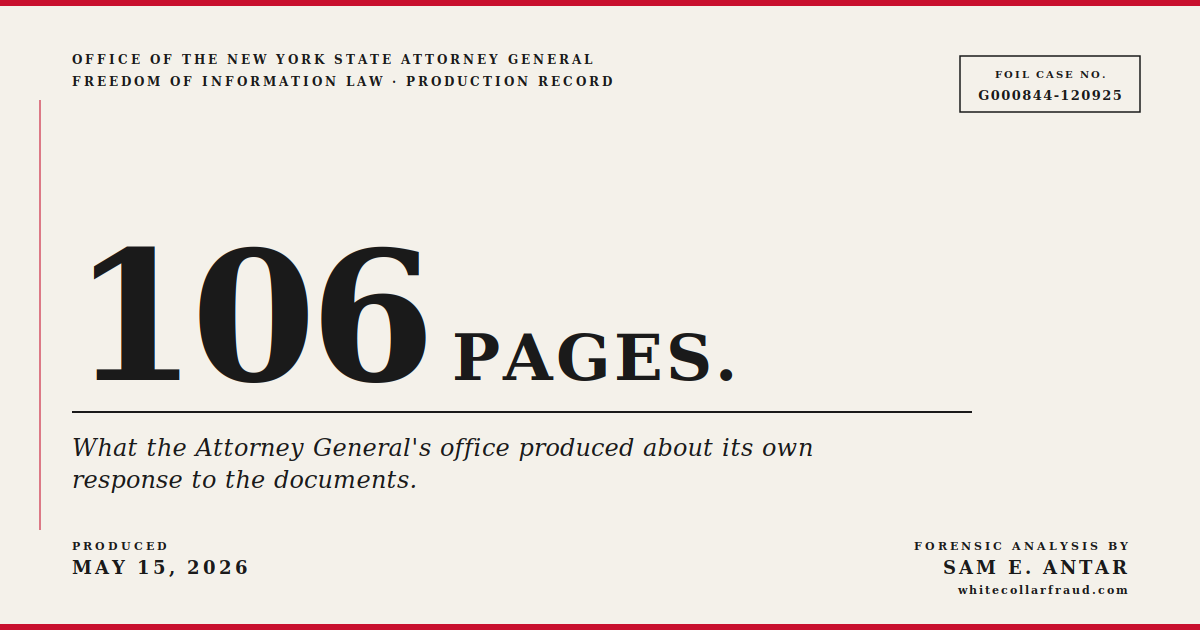
This article documents that conduct in 106 pages of records produced by the New York Attorney General’s office under the Freedom of Information Law. It also raises one question those records do not answer: Did the AG’s office receive a federal grand jury subpoena for these same records, and if so, were all responsive records produced? Download the full redacted FOIL production here.
Investigative Background
3121 Peronne Avenue, Norfolk, Virginia
My investigation of 3121 Peronne Avenue in Norfolk, Virginia documented that Letitia James disclosed a property value of $100,000–$150,000 against two mortgages totaling $250,000 to $400,000 — a loan-to-value ratio of 167% to 400%, mathematically impossible under standard lending practices.
An independent title search I commissioned established that neither disclosed mortgage exists in Norfolk County property records. The only recorded mortgage on the property is a $109,600 loan from OVM Financial, recorded August 17, 2020 and identified in the April 14, 2025 FHFA criminal referral as a Fannie Mae loan, structured as a Second Home mortgage requiring a signed Second Home Rider committing to personal use.
The OVM Financial mortgage does not appear on six consecutive annual sworn financial disclosure statements Ms. James filed with the State of New York.
604 Sterling Street, Norfolk, Virginia
My investigation of 604 Sterling Street in Norfolk, Virginia documented two contradictory representations by Letitia James separated by fifteen days. On August 2, 2023, Ms. James emailed her mortgage broker: “This property WILL NOT be my primary residence.” On August 17, 2023, she signed a notarized Specific Power of Attorney containing her sworn declaration of intent to occupy 604 Sterling Street as her principal residence.
The Power of Attorney was witnessed by two individuals, including Jennifer Levy, then the First Deputy Attorney General of New York, the second-highest-ranking official in the office Letitia James leads.
The Power of Attorney was the instrument by which Ms. James designated her niece, Shamice Thompson-Hairston, to execute the closing documents on her behalf approximately two weeks later, on August 30–31, 2023. The deed of trust executed at closing required the borrowers to occupy the property as their principal residence within sixty days. The August 17, 2023 Power of Attorney was filed in Norfolk County land records as part of the closing documentation and was never corrected, withdrawn, or amended.
296 Lafayette Avenue, Brooklyn, New York
My investigation and the independent parallel work of investigative researcher Joel Gilbert documented that the City of New York issued a five-unit certificate of occupancy for 296 Lafayette Avenue in Brooklyn on January 26, 2001 — nineteen days before Letitia James closed on her purchase of the property. Between February 2001 and 2021, Ms. James executed ten recorded mortgage or secured-lending instruments on the property — the original purchase mortgage and nine subsequent refinancings, loan modifications, HELOCs, and new mortgages. Each describes the property as one-to-four units, against the controlling municipal record listing five.
The distinction is not cosmetic. Residential mortgage products — and the favorable interest rates and underwriting terms that accompany them — are generally available only for buildings of one to four units. Buildings of five or more units are typically treated as commercial or multifamily properties, subject to stricter terms and higher rates, and are excluded from certain federally backed programs. The April 14, 2025 FHFA criminal referral specifically alleged that James misrepresented the unit count to qualify for residential financing unavailable to owners of larger buildings. Whether the discrepancy was material in any specific transaction is a question for investigators and the lenders involved; that it had the potential to affect loan eligibility and terms is why federal authorities treated it as worth examining.
Queens, New York (1983 and 2000)
Investigative researcher Joel Gilbert documented two separate Queens property transactions — one on May 20, 1983, one on May 4, 2000 — in which Letitia James was identified in recorded mortgage documents as the “husband and wife” of her own father, Robert James. The 1983 transaction was for a Jamaica, Queens property purchased while Letitia James was a single woman in her early twenties. The 2000 transaction repeated the same misrepresentation seventeen years later. The misrepresentations are documented in recorded property instruments and were attached to the April 14, 2025 FHFA criminal referral as Exhibits F and G.
The Federal Criminal Referral and Indictment
On April 14, 2025, the Director of the Federal Housing Finance Agency issued a criminal referral to the United States Department of Justice. The referral cited my published investigations and the independent parallel work of Joel Gilbert as part of the factual basis. It identified mortgage misrepresentations across three properties — 604 Sterling Street in Norfolk, Virginia; 296 Lafayette Avenue in Brooklyn, New York; and two Queens property transactions from 1983 and 2000. The referral did not include 3121 Peronne Avenue.
On October 9, 2025 — roughly eight months after my first Peronne Avenue investigation — a federal grand jury in the Eastern District of Virginia returned a two-count indictment against Letitia James in United States v. Letitia A. James, No. 2:25-CR-00122-JKW-DEM — bank fraud under 18 U.S.C. § 1344 and false statements to a financial institution under 18 U.S.C. § 1014 — based on the same OVM Financial loan I had identified in my Peronne investigation.
In its own response brief, the Department of Justice acknowledged that the charging decision was based on facts having “nothing to do with the Sterling property in Norfolk, Virginia, or property in Brooklyn, New York.” Federal prosecutors made an independent charging decision and chose the Peronne property documented in my published investigation over the properties FHFA had referred.
The indictment was dismissed on November 24, 2025 on Appointments Clause grounds — not on the merits — and two subsequent federal grand juries in December 2025 declined to return a new indictment. The forensic record I had built remains intact and available to any properly constituted federal proceeding.
The State Press Response
Two days after the April 14, 2025 FHFA criminal referral, on April 16, 2025, the official state government press office of the New York Attorney General responded to an Associated Press inquiry about the conduct under federal criminal review.
The office’s response is best understood property by property — measured against what the documents establish.
3121 Peronne Avenue. The office offered no substantive response to the documented evidence — the mathematical impossibility of the disclosed mortgages, the title search showing neither disclosed mortgage exists, the OVM Financial Second Home loan, or the absence of the OVM Financial mortgage from six consecutive annual sworn financial disclosures. Roughly eight months after my first Peronne investigation, a federal grand jury returned an indictment on the same OVM Financial loan I had identified.
604 Sterling Street. The office did not address the August 2 email, the August 17 sworn declaration, or the Jennifer Levy witness signature. The office instead offered the Associated Press a different defense — that Ms. James was not using the property as her primary residence because she lived in New York — itself contradicted by the August 17, 2023 sworn declaration in the Power of Attorney Ms. James personally signed, which was filed in Norfolk County land records as part of the closing and was never corrected, withdrawn, or amended.
296 Lafayette Avenue. The office told the Associated Press that the five-unit certificate of occupancy “was filed by the previous owner before the Attorney General owned the home.” The certificate of occupancy was issued on January 26, 2001. Ms. James closed on the property nineteen days later, on February 14, 2001. The five-unit certificate of occupancy was the controlling municipal record before she purchased the building and on every day she has owned it since. The “previous owner” framing did not address why ten subsequent recorded mortgage instruments describe the property as one-to-four units against that controlling record.
Queens (1983 and 2000). The office offered no response on the Queens transactions.
Her office characterized my forensic analysis as part of Donald Trump’s “weaponization of the federal government.” Her office conveyed that characterization to three of five media organizations through press-office staff including Press Secretary Alexis Richards and Press Secretary Halimah Elmariah. The property-specific defenses sent to the Associated Press were sent by communications director Geoff Burgan from his ag.ny.gov email address. All of the communications were sent through official state communications channels and staff resources.
Neither the communications director nor the Press Secretaries of a state government office invent property defenses on their own. They cannot. They do not have personal knowledge of who closed on what property in 2001, who lives at what address in Norfolk, or what was sworn in a notarized Power of Attorney. The factually contradicted defenses had to come from someone with access to, or knowledge of, the underlying property records — potentially Ms. James personally, her personal counsel, senior staff in her office, or some combination of them. Identifying that source is a question federal investigators are better positioned to answer than I am.
There is one question that runs through this entire record because everything else turns on it: Did the New York Attorney General’s office receive a federal grand jury subpoena for internal communications and documents related to Letitia James’s personal mortgage transactions, financial disclosures, or property holdings? If yes, were all responsive records produced — including any internal briefing materials prepared in connection with the press response documented below?
The answer is in her office’s records. I asked the question publicly on May 17, 2026. I asked the question directly to Geoff Burgan, the AG’s communications director who sent the substantive defenses to the Associated Press, on May 18, 2026. The question remains unanswered as of this writing.
A note on Mr. Burgan’s role. Geoff Burgan served as Director of Communications at the Office of the New York State Attorney General from March 2025 through February 2026, the period encompassing the April 2025 email exchanges with the Associated Press documented in this article. In February 2026 — three months before the May 15, 2026 FOIL production that is the subject of this article — Mr. Burgan was promoted to Deputy Chief of Staff at the same office. His publicly available professional profile describes his current responsibilities as “communications, policy, and external affairs.” The conduct documented in this article occurred during his Director of Communications tenure.
The FOIL Response: What Was Produced
On December 9, 2025, I filed a Freedom of Information Law request with the Office of the New York State Attorney General for all records referencing or mentioning me, my published forensic work, and the office’s responses to media inquiries about Letitia James’s personal real estate transactions, financial disclosures, and the FHFA criminal referral.
On May 15, 2026, the New York Attorney General’s office produced 106 pages of responsive records under FOIL Case G000844-120925. The production included internal AG office email communications with media organizations responding to inquiries about my published investigation and the FHFA criminal referral. The production also included a June 10, 2025 response email from the New York State Commission on Ethics and Lobbying in Government (COELIG) addressed to a separate FOIL request I had previously filed with that commission. The AG’s office has indicated that a second batch of responsive records is scheduled for production on June 15, 2026.
The 106-page production includes COELIG’s June 10, 2025 response to a separate FOIL request, which invoked Public Officers Law § 87(2)(g) and Executive Law confidentiality provisions. Whether the AG’s office is withholding additional internal press materials under similar exemptions remains a separate question addressed in detail below where it bears on the forensic findings.
What the production does confirm — affirmatively, in writing, in a page-stamped government FOIL production — is that the official press operation of the New York Attorney General responded to my forensic findings using state government infrastructure, and the responses contain demonstrable factual contradictions with other public records.
I am a forensic accountant, not a journalist. I am also a registered Democrat with no affiliation with Donald Trump, his administration, or any political organization. I have stated that publicly and repeatedly. Every finding in my investigation is sourced to public records anyone can pull — deeds, mortgage instruments, certificates of occupancy, financial disclosure statements, and federal court filings. No anonymous sources. No political agenda.
I note this because the FOIL response from the New York Attorney General’s office reveals that the office’s official press operation responded to my documented forensic findings by attacking the messenger rather than addressing the documents. The property-by-property record above is what the documents establish. What the office did with those documents — the conduct itself — raises four questions the public record cannot ignore.
Question One: The Sworn Declaration Was Witnessed by Her Own Office
The Power of Attorney James signed on August 17, 2023 — filed as Exhibit A in the federal court record, Case 2:25-CR-00122-JKW-DEM, Document 109-1 — contains the following sworn declaration in her own words:
Specific Power of Attorney — August 17, 2023 — Federal Court Record
“I HEREBY DECLARE that I intend to occupy this property as my principal residence.”
Fifteen days before she signed that declaration, on August 2, 2023, James emailed her mortgage broker: “This property WILL NOT be my primary residence.” That email was disclosed in Abbe Lowell’s April 24, 2025 letter to Attorney General Bondi — a letter intended to defend her that instead documented the contradiction in her own words.
Two individuals witnessed James sign the Power of Attorney on August 17, 2023 in Queens County, New York. One was Jennifer Levy, then First Deputy Attorney General of New York. The other was Sharona Parchment, whom I have separately identified through public records as connected to the Office of the New York State Attorney General. The witnesses were:
- Jennifer Levy — at the time of signing, the First Deputy Attorney General of New York, the second-highest-ranking official in the New York Attorney General’s office
- Sharona Parchment — identified in public records as connected to the Office of the New York State Attorney General, with a verified ag.ny.gov email address
Court Document 109-2, page 11 — filed in the same federal case — contains an employee identification stub showing Department 03009, Location: Office of the Attorney General. Department 03009 is the New York Attorney General’s office. Parchment’s employment at the office is further supported by publicly available professional records. Whether either witness acted in a personal or official capacity is not resolved by the FOIL production. The documented fact is that the Power of Attorney containing Ms. James’s sworn declaration of intent to occupy 604 Sterling Street as her principal residence was witnessed by two individuals identified in public records as connected to the office Ms. James herself leads.
The declaration they witnessed was executed in connection with a primary residence mortgage on Sterling Street at terms below those available for investment or secondary properties — a $219,780 loan with a 60-day occupancy requirement and a one-year minimum occupancy term.
As I documented in April 2025, James’s public schedule during that occupancy window was dominated by the New York civil fraud trial against Donald Trump, raising obvious practical questions about whether she could satisfy the Virginia principal-residence occupancy covenant she had sworn to establish.
The Power of Attorney containing Ms. James’s sworn declaration of intent to make Sterling Street her principal residence was witnessed by First Deputy Attorney General Jennifer Levy and by Sharona Parchment, whom public records identify as connected to the Office of the New York Attorney General. Whether each witness acted in a personal or official capacity is not resolved by the FOIL production. The declaration was executed in connection with a mortgage transaction that contained a principal-residence occupancy requirement.
Question Two: The Coordinated Press Defense — And the Failure to Refer the Inquiry to Outside Counsel
On April 1, 2025, I published my forensic investigation of the Power of Attorney and the principal residence declaration. The article quoted the declaration verbatim, cited Public Officers Law § 3(1) on the residency requirements for the Attorney General office, and asked four specific questions about her eligibility to hold her office and run for re-election.
Two weeks later, on April 14, 2025, I published a comprehensive summary article titled The Case Against NY Attorney General Letitia James to Date, which pulled together every documented finding from the prior investigations. That same evening, the Federal Housing Finance Agency filed a criminal referral to the Department of Justice that cited the same findings.
Two days after that, on April 16, 2025 at 11:29 AM, the Associated Press’s Michael Sisak emailed Burgan citing my April 14 summary article by URL alongside the FHFA criminal referral. Burgan, identified in public professional records and in City & State New York reporting as Director of Communications for the Office of the New York State Attorney General from March 2025, was at that time the senior communications official at the AG’s office.
Sisak’s email was forensically careful. He acknowledged the complexity of the underlying transactions, offered James the opportunity to “set the record straight,” and asked whether the inquiry should be redirected to outside counsel handling personal legal matters. His exact words: “I’m not sure if this is something that’s even being handled through the attorney general’s office, or if Ms. James is routing questions to outside counsel or her campaign. If so, please redirect me.”
The production contains no record showing that Burgan redirected the inquiry, told Sisak the matter was being handled by personal counsel, or forwarded the inquiry to Abbe Lowell, James’s documented personal counsel. There is no record in the FOIL production that Burgan consulted outside counsel before responding, or that the inquiry was treated as a personal legal matter requiring referral to personal attorneys. What the production shows is that the state press office answered it directly.
The AG office’s first documented response came not from Burgan but through a separate channel. By 11:39 AM on April 16, 2025 — ten minutes after Sisak’s initial 11:29 AM inquiry — a second Associated Press reporter, Anthony Izaguirre, had made direct contact with Halimah Elmariah, identified as a Press Secretary at the AG office, and had received the standard boilerplate statement characterizing my forensic analysis as part of Donald Trump’s “weaponization of the federal government.”
When the Izaguirre–Elmariah contact actually occurred is not specified in the production; the medium of contact is also not specified. The existence and substance of the resulting statement is documented in Sisak’s 11:39 AM follow-up email to Burgan referencing it: “My colleague Anthony Izaguirre connected with Halimah and received a short statement re: the weaponization of the federal government and AG James unwillingness to be bullied.”
Sisak’s 11:39 AM follow-up requested more. He asked Burgan for “a more fulsome explanation/background on these documents and anything the AG has to say to refute the specific claims made by Antar.” At 12:04 PM, Burgan acknowledged the request with a brief reply: “Understood! Will get back with you.”
At 6:37 PM that same evening, Sisak followed up a second time, asking Burgan for “a copy of the document referenced in the Times’ piece and/or any other relevant documents.” Sisak’s 6:37 PM email quoted the New York Times article published earlier that day, which had reported that “on a separate loan application form provided by the attorney general’s office, Ms. James indicated that she did not intend to occupy the property as a primary residence.” That form was the August 3, 2023 Section 5 loan application on which James checked “no” to primary-residence occupancy. As Question Three explains, that document’s August 3 date is itself significant: the “no” answer predates James’s August 17 sworn Power of Attorney declaration of occupancy intent by fourteen days.
Seven minutes after the 6:37 PM email, at 6:44 PM, Burgan responded — from his official ag.ny.gov email address, on his Outlook iOS mobile device — with the two property-specific defenses on Brooklyn and Virginia. Those defenses, both contradicted by other public records, are documented in detail in Question Three. Burgan opened his 6:44 PM email with a phone-coordination offer: “At the moment I have some background pieces I can share. I am out of pocket for the next hour or so but can talk later tonight if you’d like. Totally understand the note and happy to talk through.”
The sequence is forensically significant. The AG office’s earliest documented substantive response to AP on April 16, 2025 was the boilerplate delivered to Izaguirre through Elmariah, received by 11:39 AM. When AP pushed back through Sisak for substantive engagement, the office escalated to the property-specific defenses contained in Burgan’s 6:44 PM email. The state press operation answered the inquiry itself, twice, through two separate staff members. The AP reporter expressly offered to redirect to outside counsel. The AG’s office declined.
The production also documents that the AG office’s engagement with the Associated Press was not limited to written communications. After Burgan’s 6:44 PM substantive defenses, the email exchange turned toward phone coordination.
At 6:53 PM, Sisak wrote: “We can chat later or tomorrow morning if that’s easier.” At 8:15 PM the same evening, Burgan replied from his Outlook iOS mobile: “Ha sounds good, yes can ring in AM.”
The next day, on April 17, 2025 at 12:21 PM, Sisak followed up: “Give me a call when you have time. We’re planning something today, so that doc/docs and any other responses will be vital to ensuring we have the AG’s POV represented.” At 12:37 PM, Burgan forwarded that message to Press Secretary Alexis Richards; at 12:40 PM, Richards replied internally: “Need something from me here?”
What was said in any subsequent phone conversation between Burgan and Sisak is not captured in the 106-page production. Phone records, if they exist, are not part of an email production. They could be responsive to a federal grand jury subpoena if the subpoena sought communications or records concerning the press response or underlying mortgage allegations.
That choice is the central forensic finding of this FOIL response. The Power of Attorney was witnessed by First Deputy Attorney General Jennifer Levy and by Sharona Parchment, whom public records identify as connected to the same office. The state press office, when invited to redirect the inquiry to personal counsel, chose to defend the conduct itself using state government infrastructure — twice on the same day, through two separate staff members, with phone-coordination follow-up the next day. The sworn declaration at the center of the matter was witnessed by employees of her office. The press defense of that same conduct came from employees of her office. Same office at both ends. Same conduct. Both now in the public record.
Question Three: The Property-Specific Defenses Her Office Gave the Associated Press
Burgan’s background email to Sisak on April 16, 2025 at 6:44 PM contained two specific defenses. Both are demonstrably contradicted by public documents.
The Brooklyn building defense. On the Lafayette Avenue property in Brooklyn, the AG’s office told AP:
Background Information — Attributable to AG James Office — April 16, 2025
“The Attorney General has been clear in her financial filings that this is a 4 unit, owner-occupied building. The previous Certificate of Occupancy from January 2001 that lists it as a 5 unit building was filed by the previous owner before the Attorney General owned the home.”
This defense collapses under the nineteen-day timeline. The certificate of occupancy was issued by the City of New York on January 26, 2001, following a Department of Buildings inspection that confirmed the five-unit status. James closed on the purchase of the property on February 14, 2001 — nineteen days later. The CO documenting the building as five units was issued before she owned it. She purchased a building already officially documented — and inspected — as five units. The “previous owner” framing is true in the narrowest technical sense and entirely irrelevant to what she has been disclosing under oath ever since. She has filed every mortgage application, every building permit application, and every state financial disclosure since 2001 describing a building as four units when the city-issued, inspection-confirmed CO she received at closing documented five.
The “previous owner” framing fails on a second independent ground. James closed on the Brooklyn property with a mortgage in place on February 14, 2001 — nineteen days after the five-unit certificate of occupancy was issued. The five-unit CO existed before closing and would ordinarily be expected to have been part of the closing diligence record. Her attorney, her title insurer, and her lender would ordinarily be expected to review the then-current certificate of occupancy as part of closing. The certificate of occupancy is the controlling municipal record. A property owner’s subsequent representations to lenders, regulators, and the State of New York require explanation if they conflict with that record. The CO governs.
The “previous owner” framing fails on a third and dispositive independent ground. Public mortgage records reflect ten recorded mortgage or secured-lending documents involving the Brooklyn property between February 14, 2001 and 2021 — the original purchase mortgage and nine subsequent refinancings, loan modifications, HELOCs, or new mortgage transactions. Each describes the property as one-to-four units despite the controlling January 26, 2001 certificate of occupancy listing five units.
Each subsequent mortgage, refinancing, loan modification, HELOC, or recorded secured-lending transaction would ordinarily be expected to involve some combination of underwriting review, title review, property description, and borrower representations. Across twenty years and ten transactions, the five-unit certificate of occupancy is the controlling municipal record.
Either Ms. James and the diligence teams across all ten transactions repeatedly failed to identify a publicly recorded city document, or the five-unit certificate was identified at some point during those transactions, and her four-unit or one-to-four-unit representations were nevertheless submitted. None of those possibilities reconciles the repeated one-to-four-unit representations with the controlling five-unit municipal record. The “previous owner” framing offered by Burgan to AP on April 16, 2025 does not address it.
In fairness, the materiality of the unit-count discrepancy is contested. The Associated Press quoted a New York housing-law professor who said that going from five units to four “doesn’t really help her” for rent-regulation or income purposes and that the difference was unlikely to be “legally consequential” on its own. That view addresses one dimension — rent regulation — but does not address the lending dimension the FHFA referral raised: that a one-to-four-unit description is what qualifies a property for residential rather than commercial financing, including the 2011 federally backed HAMP modification that, by program rules, was unavailable to buildings of five or more units. Whether that crossed a legal line in any specific transaction is for investigators to determine. The records establish that the description was made repeatedly, over two decades, against a controlling municipal record that said otherwise.
The Sterling Street defense. On the Virginia property, the same email stated:
Background Information — Attributable to AG James Office — April 16, 2025
“The Attorney General bought a property with her niece because her father instilled in her the importance of owning property to build generational wealth. Her niece lives in the home as a primary residence and the AG has been clear that she is not using the Virginia home as her primary residence, because she lives in New York.”
This defense is contradicted by the documents Ms. James personally signed and that bind the closing. The August 17, 2023 Sterling Street deed of trust required both borrowers to occupy the property as their principal residence within 60 days and maintain that occupancy for at least one year.
The Power of Attorney Ms. James personally signed and notarized on August 17, 2023 — approximately two weeks before the August 30–31, 2023 closing — contains her sworn declaration of intent to occupy the property as her principal residence. That Power of Attorney was the instrument by which Ms. James authorized her niece, Shamice Thompson-Hairston, to execute the closing documents on her behalf, and it was filed in Norfolk County land records as part of the closing documentation.
The press office told AP the niece lives there as primary residence. The closing documents say both borrowers — Ms. James included — would occupy the property as their principal residence. Both positions cannot be true. Both are now in the public record.
Her office did not address either contradiction. Her office did not offer corroborating documentation for either defense. Her office did not produce the deed amendment, the occupancy waiver, or any document showing that the sworn occupancy requirement had been modified or excused. Those documents do not appear in this FOIL production. They do not appear anywhere else in the public record.
There is one more finding that requires careful attention — and it concerns a document the Attorney General’s office affirmatively shared with the press to defend Ms. James.
On April 16, 2025 at 6:37 PM, Sisak wrote back to Burgan, quoting the New York Times article published earlier that day and requesting a copy of a document the Times had referenced:
From Michael Sisak, Associated Press — April 16, 2025 6:37 PM
“Circling back — can you provide a copy of the document referenced in the Times’ piece and/or any other relevant documents?”
“Virginia real estate lawyers said that the paperwork might be an issue if Ms. James had misrepresented the truth to the lender. But on a separate loan application form provided by the attorney general’s office, Ms. James indicated that she did not intend to occupy the property as a primary residence. Her mortgage agreement did not require her to do so.”
The Times reported, and the Associated Press confirmed three days later, that the Attorney General’s office shared a loan application form on which James indicated she did not intend to occupy the Virginia property as a primary residence. The AP reported in its April 19, 2025 article that the form asked, “Will you occupy the property as your primary residence?” — and James “checked the box that said ‘no.'”
The Attorney General’s office offered that document as a defense: it showed, the office argued, that James was honest about not intending to live in Virginia, and that her mortgage did not require her to.
That document is the Section 5 declaration form attached to an August 3, 2023 email from James’s mortgage broker, Michael Voci — the same email and form that Abbe Lowell later submitted as Exhibit A to his April 24, 2025 letter to Attorney General Bondi, and that I published and analyzed in detail on May 6, 2025. The “NO” answer on primary-residence occupancy is dated August 3, 2023. The notarized Power of Attorney in which James swore “I HEREBY DECLARE that I intend to occupy this property as my principal residence” is dated August 17, 2023 — fourteen days later.
The defense document the Attorney General’s office chose to share with the press does not resolve the contradiction. It establishes it. On August 3, 2023, James was recorded answering “no” to occupying the Virginia property as her primary residence. On August 17, 2023, she swore under penalty of perjury that she intended to occupy that same property as her principal residence. The August 3 form is the document that proves she had already answered the occupancy question one way fourteen days before she swore the opposite under oath.
The broker’s own August 3 email, which transmitted that form, reads: “Section 4 indicates that the property will be occupied as a primary residence for Shamice. The loan is originated as a primary residence. Your declaration is marked as a non-occupying co-borrower. The file is set up correctly and rate is locked as a primary residence.” The loan was originated as a primary-residence product — at primary-residence rates — with James as a non-occupying co-borrower. The favorable rate depended on primary-residence occupancy. Two weeks later, James supplied the sworn occupancy declaration on the recorded Power of Attorney.
This sequence — the August 3 “no,” the August 17 sworn “yes,” and the primary-residence rate lock in between — is documented in my May 6, 2025 analysis. Both the New York Times and the Associated Press reported that the August 3 form was provided by “the attorney general’s office” and presented it as exculpatory. In a forensic reading, the document is the opposite of exculpatory: it establishes that James answered the occupancy question “no” fourteen days before swearing the opposite under oath.
There is a question of sequence that the records raise and do not answer. The August 3 loan-application form was a document from Ms. James’s personal mortgage file. Her personal counsel, Abbe Lowell, formally filed it as Exhibit A to his April 24, 2025 letter to U.S. Attorney General Pam Bondi. But the document had already appeared in the national press more than a week earlier: the New York Times reported it on April 16, and the Associated Press reported it on April 19. Both attributed it to “the attorney general’s office.” A personal legal-defense exhibit was in the hands of national reporters before the Attorney General’s own lawyer filed it through formal channels.
The FOIL production does not, by itself, resolve who physically transmitted the document to the New York Times. The Times described it in its own words as “provided by the attorney general’s office” — language that, on its face, points to the state office rather than to outside counsel, whom the Times distinguishes elsewhere in the same article. What the production independently shows is that after the document appeared in the Times, the Associated Press asked the state Attorney General’s press office to provide a copy — Sisak’s 6:37 PM email to Burgan requested “a copy of the document referenced in the Times’ piece.” A national news organization directed a request for a document from Ms. James’s personal mortgage file to state government communications staff, and that request is documented in the state office’s own records.
Who supplied a personal mortgage-defense document to the national press, on what date, and through what channel — state office or personal counsel — is a question the records pose but do not close. The next FOIL production may.
That is the heart of what this FOIL production documents. The press inquiries concerned a personal mortgage file. The defenses came from state government communications staff. The document at the center of the Virginia defense — the August 3 loan application — was being handled as a press matter by the office of the very official whose personal criminal exposure was at issue. The framing offered around that document was incomplete in a way that mattered: it presented the August 3 “no” as proof of honesty while omitting that the same official swore the opposite under oath fourteen days later. The contradiction the document actually established went unreported at the time.
This is not a press office answering a routine question about official business. It is a state government communications operation engaged with national coverage of the personal criminal exposure of the Attorney General — the very official who controls that communications operation. Whether that crosses a legal line is a question for others. That it happened is documented in the office’s own records.
Question Four: Where Are the Internal Documents That Prepared These Defenses?
Geoff Burgan did not invent those defenses on the spot.
When the AP called, Burgan responded with two specific, legally precise explanations involving New York City certificate of occupancy regulations, Virginia mortgage requirements, co-ownership representations, and 2001 property purchase chronology. Both explanations required knowledge of underlying documents. Both required familiarity with the specific transactions. The specificity of the response — written from Burgan’s Outlook iOS mobile device seven minutes after Sisak’s 6:37 PM email, while Burgan was “out of pocket” — raises the question of who prepared, approved, or supplied those defenses. If briefing materials, talking points, drafts, or coordination emails were prepared, they are not included in the 106-page production.
The following are the kinds of records ordinarily expected in a coordinated press response and should be requested or subpoenaed directly:
- Internal talking points or press guidance prepared in advance of media responses, identifying specific defenses for specific allegations
- Internal emails between Burgan and James’s personal attorneys or her chief of staff, consulted before the AP response was drafted
- Internal emails between AG staff and James herself, who would have been notified that AP was calling and consulted on what to say
- Any briefing memo or fact sheet prepared to coordinate the press response to my published investigation and the FHFA referral
The 106-page production does not include the internal briefing materials, talking points, drafts, or coordination communications that would ordinarily be expected to accompany a coordinated press response of this nature. The production includes COELIG’s June 10, 2025 response to a separate FOIL request, which invoked Public Officers Law § 87(2)(g) and Executive Law confidentiality provisions. Whether the AG’s office is withholding additional internal press materials under similar exemptions is a separate open records question.
FOIL exemptions govern public disclosure. They do not determine what ethics investigators, a grand jury, or a court could compel through subpoena, investigative demand, or court order. If internal records were used to prepare factual defenses later contradicted by public records, those records remain significant evidence regardless of whether they are publicly disclosable under FOIL.
The question is not what Burgan said to AP. The question is who told him what to say — and whether the people who prepared those specific defenses knew they were factually contradicted by public records when they did so.
If such briefing materials were prepared, they should exist somewhere in AG office records or in communications with outside counsel or staff. They would show who prepared the defenses, what documents were reviewed in preparing them, and who approved them before they were offered to a major media organization. They have not been produced to any public record I have reviewed. I am filing additional FOIL requests to obtain them. The denial of those requests — and the specific exemptions invoked — will be reported here when received.
The Pattern: Three Identical Boilerplate Responses, Two With No Outbound Reply in the Production
Five media organizations submitted documented press inquiries about my investigation, the FHFA criminal referral, or specific property and mortgage allegations: the Associated Press, Fox News Digital, 1010 WINS, the Daily Mail, and Newsweek.
Three of the five received the same core response. Two outlets — 1010 WINS and Fox News Digital — received an identical written statement sent by Alexis Richards, who served as Press Secretary of the New York Attorney General’s office from June 2023 through September 2025 — the named official spokesperson for the office. Her transmission of the statement is documented in the FOIL response by her own signature: she sent the statement personally to John Davis at 1010 WINS on April 15, 2025, and personally to Michael Dorgan at Fox News Digital on April 17, 2025, each time from her ag.ny.gov address.
The Associated Press received the same core message through Halimah Elmariah, identified on publicly available profile information as a Press Secretary at the same office, according to AP reporter Michael Sisak’s 11:39 AM April 16, 2025 follow-up email describing what his colleague Anthony Izaguirre had received. Elmariah’s delivery of the statement to Izaguirre preceded the Burgan-to-Sisak written exchange documented in Question Two and represented the AG office’s earliest documented substantive response to AP in the FOIL production.
For the Daily Mail and Newsweek inquiries, I have not located any outbound response from the AG’s office in the 106-page FOIL production.
Official Response — Sent by Alexis Richards / Attributed to a Spokesperson for the Office of the Attorney General
“Attorney General James is focused every single day on protecting New Yorkers, especially as this Administration weaponizes the federal government against the rule of law and the Constitution. She will not be intimidated by bullies – no matter who they are.”
Not one substantive response to any specific allegation. Not the phantom mortgages. Not the certificate of occupancy. Not the OVM Financial mortgage that has never appeared on any of six consecutive annual financial disclosures. Not the Sterling Street principal residence declaration. Just “bullies.”
The Burgan AP background email went further — characterizing my forensic analysis as “Donald Trump’s weaponization of the federal government” and the documented findings as “cherry-picked information” used to attack the Attorney General.
I am a registered Democrat. My analysis was published April 1, 2025 — almost two weeks before the FHFA criminal referral. It is sourced to public records anyone can pull. The Trump weaponization framing is now a government record. So is the cherry-picked characterization. And across the five documented inquiries — three engaged with, two ignored — her office never identified a single document that would refute a single specific allegation. If the information was cherry-picked, the response is to produce the documents that were left out. Her office never did.
The Newsweek inquiry warrants closer attention because it sharpens the pattern. On April 24, 2025 at 9:16 AM, Andrew Stanton of Newsweek emailed the AG’s official press office address — NYAG.PressOffice@ag.ny.gov — with the subject line “Newsweek Press Inquiry.” He wrote that he had been assigned a Newsweek article about my April 23, 2025 publication documenting New York City Department of Buildings records that validate the five-unit certificate of occupancy on the Brooklyn property. He asked whether Ms. James wanted to comment. He set a 10:30 ET deadline.
At 9:27 AM the same morning, Mr. Stanton sent a follow-up referencing my second WhiteCollarFraud article on the same topic. At 9:28 AM, the NYAG PressOffice forwarded both inquiries to Geoff Burgan and Alexis Richards. At 9:30 AM, Richards responded internally with two words: “Thank you.”
I have not located any outbound response from the AG’s office to Mr. Stanton in the 106-page FOIL production. Either the office decided not to respond to Newsweek, responded through channels not captured in the production, or routed the inquiry to outside counsel without retaining the response in the FOIL-searchable record. All three possibilities are forensically significant. The first two implicate the same pattern of selective state-press engagement on personal legal matters. The third would implicate outside-counsel coordination that the office has not otherwise documented.
Newsweek’s published April 24, 2025 article independently confirms the silence. The piece states that Newsweek “reached out to James’ office for comment via email,” and it contains no response from her office — corroborating, from outside the FOIL production, that the office received the inquiry and did not provide a substantive answer. The contrast is documented on both sides of the same exchange: the office’s internal forwarding chain appears in its own FOIL production, and the absence of any reply appears in Newsweek’s published reporting.
The Stanton inquiry also placed the AG’s office on direct written notice of the DOB records validating the five-unit certificate of occupancy — eight days after Burgan had told AP the five-unit CO was filed by the previous owner. I have not located any record in the 106-page production showing that the office corrected, supplemented, or withdrew the prior framing after receiving Stanton’s inquiry. The “previous owner” defense remained the office’s documented position on the Brooklyn property despite written notice that NYC DOB records confirmed the contrary.
The Question of State Resources
Every documented outbound press response in this FOIL production came from official New York State government email addresses — ag.ny.gov — sent by staff of the New York Attorney General’s office. The subject matters were personal: personal mortgage transactions, personal property purchases, personal financial disclosure filings, personal criminal exposure.
New York Public Officers Law § 74 — the state’s code of ethics — provides that state officials shall not use state property, services, or other resources for non-governmental purposes. Whether the press responses documented here cross that line is a question for the New York State Commission on Ethics and Lobbying in Government (COELIG), not a conclusion I am positioned to draw.
The context makes the boundary question more pointed. In May 2025, the New York State budget created a $10 million state legal-defense fund available to state officials facing allegedly retaliatory federal action. According to Politico and the New York Post, Ms. James’s office indicated she would not draw on that state fund and would instead rely on a private legal-defense fund operated by the Democratic Attorneys General Association.
Her 2025 annual financial disclosure statement, Item 9, Gifts, lists a member-provided legal defense fund from DAGA, valued at $250,000 to under $350,000, and describes it as accepted pursuant to COELIG Advisory Opinion 25-03.
The boundary question follows directly. If the legal defense was funded outside direct state reimbursement, why was the public response to inquiries about the same underlying mortgage and property allegations handled through official AG staff, official ag.ny.gov email accounts, and state press infrastructure?
Private political money for the lawyers. State government staff for the press. Both addressing the same personal conduct.
Response to Pre-Publication Inquiry
On Monday, May 18, 2026, I provided advance notice of this article and its key findings to seven individuals identified in the FOIL production or with documented connection to the subject matter: Michael Sisak of the Associated Press; Geoff Burgan, who served as Communications Director of the Office of the New York State Attorney General at the time of the April 2025 emails documented above and is now Deputy Chief of Staff at the same office; Alexis Richards, who served as Press Secretary at the same office through September 2025; Abbe Lowell, Ms. James’s personal counsel; Michael Dorgan of Fox News Digital; John Davis of Audacy / 1010 WINS; and James Cirrone of the Daily Mail.
I requested responses by Thursday, May 21, 2026 at 5:00 PM Eastern.
As of that deadline, one of the seven recipients responded. John Davis at Audacy / 1010 WINS acknowledged receipt and indicated the inquiry had been routed through counsel. Six recipients — Sisak, Burgan, Richards, Lowell, Dorgan, and Cirrone — provided no response.
The pattern of selective engagement documented in the FOIL production — three of five media organizations engaged through state press infrastructure, two received no documented outbound reply — extended through the pre-publication notice phase of this article. Of seven direct inquiries delivered under deadline, six produced no response from named individuals positioned to address the documented findings.
The Unanswered Question: Did the Federal Grand Jury Ever See These Documents?
The original federal indictment of Letitia James was filed October 9, 2025. The press response records documented here existed within the AG’s office throughout the period leading up to that indictment, and throughout the period of the two subsequent grand juries in December 2025 that declined to indict. The records were produced to me under FOIL only after a December 9, 2025 request — filed during the active second-round grand jury proceedings and well after the original October 9, 2025 indictment had been returned.
The records — including the Burgan email containing the demonstrably false Brooklyn CO defense — existed in the AG’s office throughout the grand jury proceedings. Grand jury subpoenas override FOIL exemptions. If federal investigators subpoenaed the AG’s office, the Public Officers Law exemptions that limited my FOIL response would not have applied.
I do not know whether a grand jury subpoena was ever issued. That information is protected under Federal Rule of Criminal Procedure 6(e). But the question is significant. If the grand jury had the Burgan AP email — demonstrating the AG office’s coordinated press response containing defenses that are contradicted by other public records — and two grand juries still declined to indict, that is one set of conclusions. If the grand jury never had it, that is a completely different set of conclusions about what was presented and what was not.
The indictment was dismissed without prejudice. The Department of Justice retains the ability to re-indict with a properly appointed prosecutor. These documents are now in the public record regardless.
There is a related question that follows from the timing. If federal investigators did subpoena the AG’s office, and if any party knowingly withheld documents containing evidence of coordinated press communications about the conduct being investigated, the federal obstruction statutes — 18 U.S.C. § 1512(c)(2) (obstruction of an official proceeding), 18 U.S.C. § 1503 (obstruction of justice), and 18 U.S.C. § 1519 (concealment of records in a federal investigation) — would all be potentially implicated. I am not in a position to determine whether subpoenas were issued, whether productions were complete, or whether any withholding was done with the knowledge required to trigger those statutes. Those determinations belong to federal investigators. What I can document is that the records existed, the investigation existed, and the question of what was produced to whom remains unanswered in the public record.
Two Items the FOIL Response Produced That Should Be Noted
On April 19, 2025, three days after AP began its inquiry, someone sent an email to the AG’s official scheduling address — AG.Schedule@ag.ny.gov — with the subject line “SAM ANTAR IS MY HERO. I THOUGHT YOU SHOULD KNOW!” The AG’s office produced this email as a responsive record under my FOIL request. The official scheduling email account of the New York Attorney General determined that a fan letter was relevant to my investigation of Letitia James’s financial disclosures. I will leave that without further comment.
Fox News Digital reporter Michael Dorgan submitted his press inquiry about the FHFA criminal referral with the subject line “Criminal referral and SAmmy Antar allegations.” He spelled my name with a capital S, lowercase m, capital A. That misspelling is now a produced government record. Alexis Richards, then Press Secretary of the AG’s office, responded with the standard boilerplate. She did not correct the spelling.
What the Documents Establish
What the FOIL response establishes:
- The Power of Attorney containing Letitia James’s sworn declaration of intent to make Sterling Street her principal residence was witnessed by First Deputy Attorney General Jennifer Levy and by Sharona Parchment, whom public records identify as connected to the Office of the New York Attorney General — fifteen days after Letitia James had written that the property would not be her primary residence
- The same official state government office, two days after the Federal Housing Finance Agency filed its criminal referral, coordinated a press response that it then disseminated to three of the five media organizations that submitted inquiries
- The Brooklyn building defense her office gave the Associated Press is contradicted by nineteen days and a city-issued certificate of occupancy
- The Sterling Street defense her office gave the Associated Press is contradicted by the mortgage documents she personally signed
- The August 3, 2023 loan-application form — reported by the New York Times and Associated Press as “provided by the attorney general’s office” and presented as exculpatory, showing James answered “no” to primary-residence occupancy — predates by fourteen days the August 17, 2023 sworn Power of Attorney in which she declared the opposite under oath; the document offered as a defense establishes the contradiction rather than resolving it
- Her office characterized my forensic analysis — published by a registered Democrat using only public records — as Donald Trump’s weaponization of the federal government
- The internal documents, talking points, or briefing materials that may have prepared those property-specific defenses are not included in the 106-page production and remain an open records question
What the FOIL response does not establish:
- Whether the use of state press resources for personal legal matters constitutes a violation of Public Officers Law § 74 — that is a question for COELIG
- Whether a federal grand jury subpoena was ever issued to the AG’s office — that information is protected under Rule 6(e)
- Whether James personally approved the specific defenses offered in the Burgan email — the email is attributable to her office, not to her personally
I published the smoking gun on April 1, 2025 and the comprehensive case on April 14, 2025. The signed declaration. The contradicting email. The mortgage documents executed at closing. The Power of Attorney was witnessed by First Deputy Attorney General Jennifer Levy and by Sharona Parchment, whom public records identify as connected to the same office. Her office responded two days after the FHFA criminal referral — not by referring the inquiry to outside counsel as the AP reporter expressly offered, but by telling the Associated Press the documents were cherry-picked, that I was part of Donald Trump’s weaponization of the federal government, and offering two new defenses that are themselves contradicted by other public records. The state press office coordinated the response after public exposure. The same office at both ends. The internal documents that may have prepared the defenses have not been produced. I am filing additional FOIL requests to find them.
— S.E. Antar
The New York Attorney General’s office has indicated that a second batch of responsive records under FOIL Case G000844-120925 is scheduled for production on June 15, 2026. Those records, and any new findings they reveal, will be reported here as received.
I will update this analysis as new documents become available. I have been wrong before. When I am wrong, I correct it publicly. That is the standard I hold myself to. It should be the standard applied to everyone in public life who signs documents under oath.
By Sam E. Antar | May 22, 2026 | WhiteCollarFraud.com
Sam Antar is a former CFO of Crazy Eddie who committed securities fraud before cooperating with federal authorities. He has spent over 30 years training the FBI, SEC, and DOJ on fraud detection. He follows the documents, not the politics.
Follow @SamAntar on X
Disclosure: I am a former felon who committed securities fraud at Crazy Eddie before cooperating with federal authorities. I have spent over 30 years as a consultant and educator on fraud detection for the FBI, SEC, DOJ, and other law enforcement agencies. This analysis is based exclusively on public records and sourced reporting. Nothing in this report constitutes a legal conclusion. Where I characterize something as a documented fact, I have linked to its primary source. Where I draw an inference, I have said so explicitly. I am a registered Democrat. My investigations follow documents, not politics.
© 2026 Sam Antar. All rights reserved.